Churro
What is a churro?
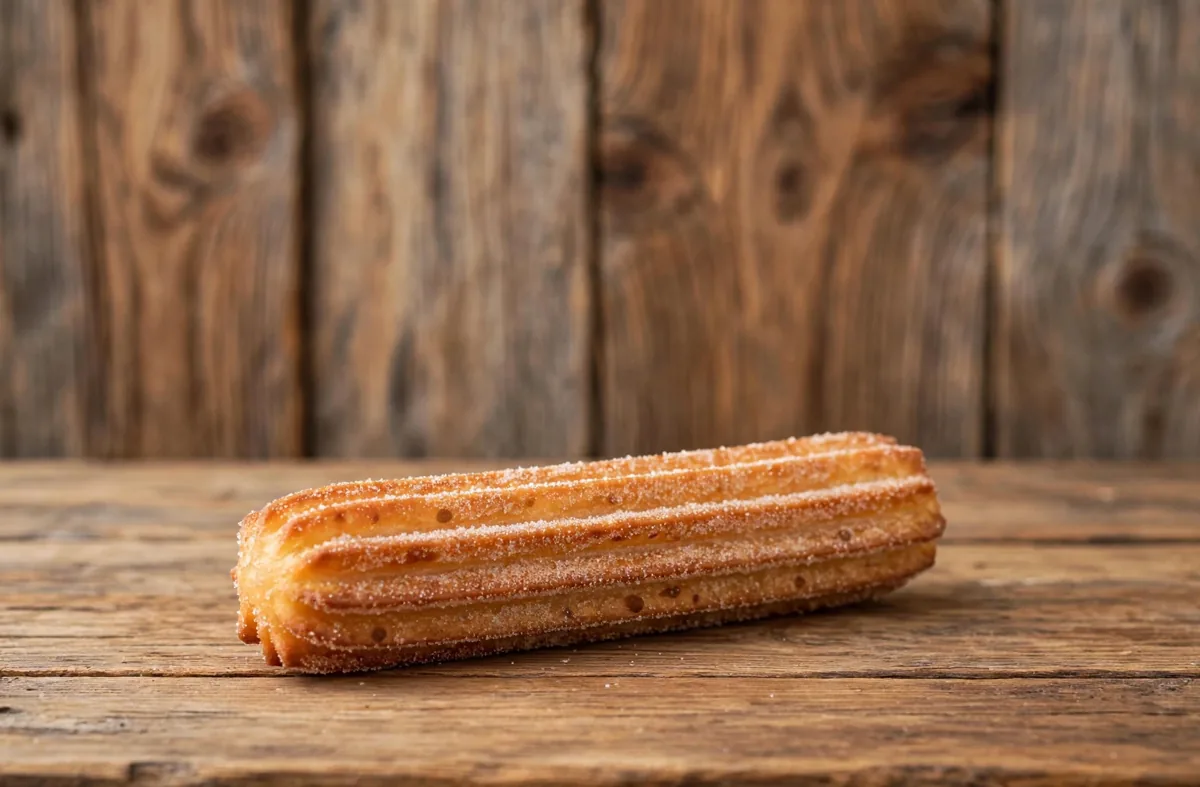
A churro is a long, ridged stick of fried dough, crisp and golden on the outside and soft and slightly doughy within, usually rolled in sugar. The dough is made from flour, water and salt, piped through a star-shaped nozzle straight into hot oil, and eaten warm within minutes of frying. It contains no yeast or baking powder.
In Spain churros are a breakfast and a late-night ritual, dipped into a cup of hot chocolate so thick a spoon can almost stand in it. In Mexico and across Latin America they are a street snack rolled in cinnamon sugar and often filled. In the United States they have become a standard at amusement parks and festivals. Few fried pastries have spread so far or are so simple.
History of the churro
An origin nobody can prove
The origin of the churro is unclear, and the honest answer is that nobody knows. Two main stories compete, and both are plausible but unproven.
The first says that churros were invented by Spanish shepherds in the mountains, who made a simple dough of flour, water and salt and fried it in a pan over a fire, far from any bakery. In this version, the name comes from the Churra sheep, a Spanish breed whose horns are ridged much like the pastry, though that is a likely guess and not a documented fact.
The second says that Portuguese traders encountered youtiao, the long fried dough sticks eaten for breakfast in China, when their ships reached China in the early 1500s, and brought the idea home, where Spaniards adapted it by piping the dough through a star-shaped nozzle instead of pulling it. The resemblance is real, but historians say it is hard to rule in or out, because fried dough is such a spontaneous, universal invention. The food historian Michael Krondl points out that today's churro is not very different from much older recipes for fried flour-and-water dough.
Chocolate and the Madrid churrería
What is better documented is how Spain made the churro its own. The pastry became inseparable from hot chocolate, which in Spain developed into a thick, sweet drink that suits dunking. In the nineteenth century, specialist chocolate shops appeared in Madrid, famous for pairing churros with it. The best known is Chocolatería San Ginés, which opened in 1894 near the Puerta del Sol, is open around the clock and has served churros and chocolate in the same spot ever since.
Across the Atlantic
Churros crossed the Atlantic with the Spanish and changed in every country they reached. In Mexico they became thicker and sweeter, rolled in cinnamon sugar and filled with cajeta (goat's-milk caramel), chocolate or dulce de leche. Filled, straight churros are also found in Cuba, Brazil, Argentina, Bolivia, Peru and Chile, where dulce de leche is a common filling. In the United States, the churro became an amusement-park and festival food.
Timeline: key dates
- Early 1500s: The first Portuguese ships reach China, the route on which the theory linking churros to Chinese youtiao depends.
- 19th century: Specialist chocolate shops open in Madrid, becoming famous for churros and hot chocolate.
- 1894: Chocolatería San Ginés opens in Madrid and begins serving churros with hot chocolate, which it still does today.
- Over time: Churros spread across Latin America, where Mexican versions add cinnamon sugar and fillings, and later to the United States.
Ingredients
The ingredient list is minimal.
- Flour: plain (all-purpose) wheat flour, which is cooked into boiling water.
- Water: boiled with the salt before the flour is added.
- Salt: seasons the dough and balances the sugar later.
- Optional extras: some recipes add butter, a little sugar or an egg for a richer, more choux-like dough. The traditional Spanish dough is usually just flour, water and salt.
- Oil: a neutral frying oil, such as sunflower or olive oil, in a deep pan.
- Sugar and cinnamon: for rolling the churros. Spanish churros are often only sugared, while Mexican ones are usually coated in cinnamon sugar.
- Chocolate: thick hot chocolate for dipping, or sauces such as dulce de leche.
A basic dough for about 12 churros uses roughly 250 ml water, 150 g flour and a pinch of salt.
How churros are made
- Cook the dough. Bring water and salt to a boil, remove the pan from the heat and add all the flour at once. Stir vigorously until a smooth, thick dough forms, similar to the first stage of choux pastry.
- Cool slightly and pipe. Let the dough cool a few minutes, then fill a piping bag fitted with a large star-shaped nozzle, about 1.5 cm wide.
- Heat the oil. Heat the frying oil to between 175 and 190°C (350 and 375°F).
- Fry. Pipe the dough directly into the hot oil, cutting it into lengths of 12 to 15 cm with scissors. Fry for 1 to 2 minutes per side, until deep golden.
- Drain. Lift out the churros and drain them briefly on paper towels.
- Coat and serve. Roll in sugar, or cinnamon sugar, while still hot, and serve immediately with hot chocolate or a dipping sauce.
Be careful when frying: hot oil spits, and wet dough or a crowded pan can cause dangerous splatters.
What a great churro looks like
- Color: deep golden brown, evenly colored along its ridges.
- Shape: straight or gently curved, with sharp, well-defined ridges.
- Crust: thin and crisp, with a distinct crunch.
- Interior: soft, tender and slightly chewy, not raw or greasy.
- Freshness: warm, fried to order and eaten within minutes.
Variations
- Spanish churros: thin or looped, lightly sugared, often eaten for breakfast with very thick hot chocolate.
- Porras: a thicker, fluffier cousin of the churro, popular in Madrid.
- Calentitos (Seville): the name sometimes used for churros in Seville, in Andalusia.
- Mexican churros: thicker and straight, coated in cinnamon sugar and sometimes filled with cajeta, chocolate or dulce de leche.
- Filled churros: stuffed with dulce de leche (Argentina and elsewhere), guava (Cuba) or chocolate or doce de leite (Brazil).
- Churros con chocolate: the classic Spanish pairing of churros and a cup of thick drinking chocolate.
- Churro-flavored products: cereals and snack bars borrow the flavor, though they are only inspired by the original.
Common problems and fixes
- Greasy churros: the oil was too cool, so the dough absorbed it. Keep the oil at 175 to 190°C and do not crowd the pan.
- Raw, doughy centers: the churros were fried too fast or at too high a heat. Lower the temperature and fry a little longer.
- Churros burst or explode: the dough had air pockets, or no ridges were piped. Use a star nozzle and let the steam escape.
- Soft, limp churros: they sat too long. Serve right after frying.
- Dense, heavy texture: the dough was too stiff or overmixed. Use a little more water.
- Sugar won't stick: the churros cooled too much. Roll them while still hot.
Serving and storing
Churros are best eaten within minutes of frying, ideally with a cup of thick hot chocolate, café con leche or a dipping sauce. Leftovers soften quickly and are best reheated in a hot oven for several minutes to bring back the crispness. Unfried dough can be piped and frozen, then fried straight from the freezer.
Nutrition snapshot
Fried and sugared, churros are energy-dense. USDA survey data lists about 419 calories per 100 g, with roughly 22 g of fat, 49 g of carbohydrate (about 23 g of it sugar) and 6 g of protein. A typical small churro of about 26 g provides around 115 calories, so a plate of six plain churros comes to roughly 600 to 700 calories before any chocolate. Churros contain wheat.
Frequently asked questions
Are churros Spanish or Mexican?
Churros are generally traced to Spain, and they traveled to Mexico and the rest of Latin America, where they changed. Spanish churros are usually thinner, lightly sugared and dipped in very thick hot chocolate, while Mexican churros are typically thicker, rolled in cinnamon sugar and often filled with cajeta, chocolate or dulce de leche.
Who invented churros?
Nobody knows. One theory credits Spanish shepherds, who may have named the pastry after the ridged horns of the Churra sheep. Another says Portuguese traders brought the idea of fried dough sticks from China, where they are known as youtiao. Neither has been proven.
Why do churros have ridges?
The dough is piped through a star-shaped nozzle. The ridges increase the surface area, which makes the outside crisper, and they stop the dough from bursting as it fries.
What is the difference between churros and porras?
Porras are a thicker version of the churro, popular in Madrid and elsewhere in Spain. They are fluffier inside and are usually cut into short lengths.
How do I keep churros crisp?
Fry them at a steady temperature, between about 175 and 190°C, drain them well and eat them within minutes. Their crispness fades quickly as steam softens the crust, which is why Spanish churrerías fry them to order.
Related pages
Sources
- Wikipedia, Churro
- South China Morning Post, Did churros, beloved in Spain and Portugal, come from China, where fried dough sticks are also a breakfast staple?
- Mexico News Daily, Churros: a delicious treat with an ancient history
- The Takeout, The history of churros is much more mysterious than we thought
- History Cooperative, Origin of churros
- USDA FoodData Central: Churros