Éclair
What is an éclair?
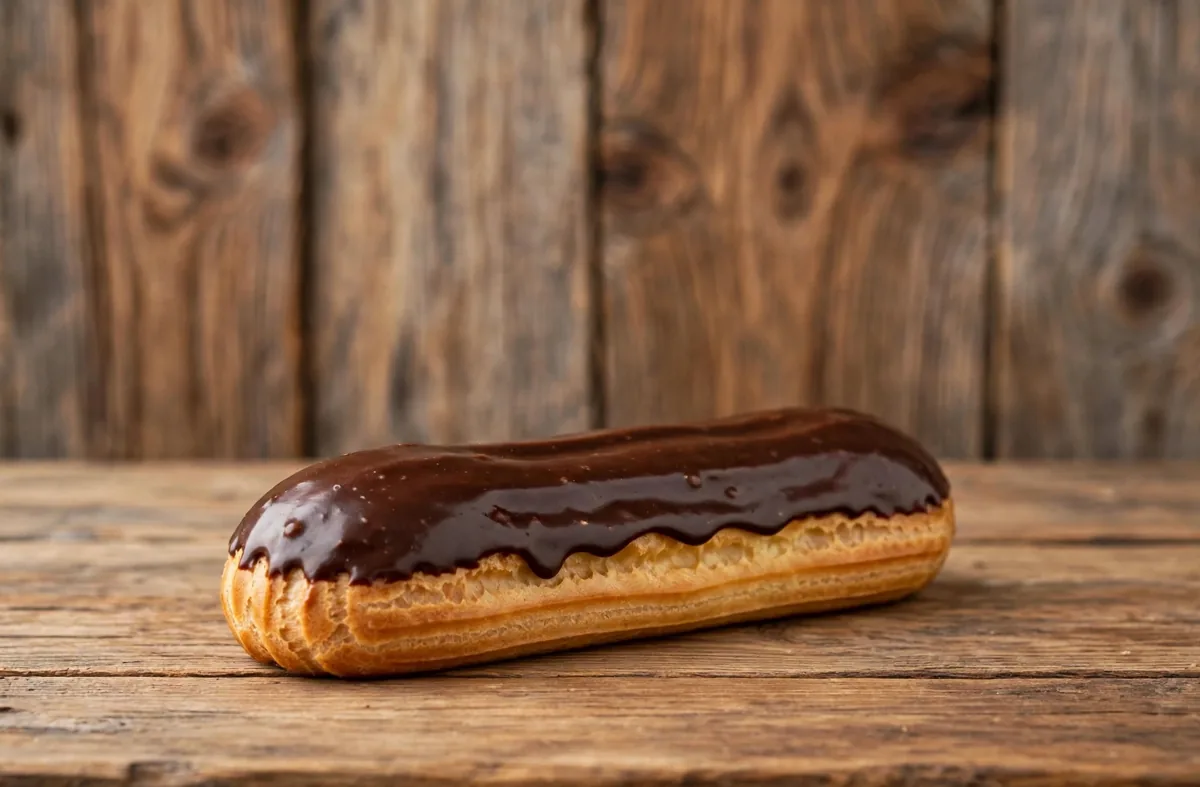
An éclair is a long, finger-shaped pastry made from choux dough, a light, hollow, crisp-shelled paste, filled with pastry cream and topped with a glossy glaze, most often chocolate. It is about 12 to 14 cm long, golden outside and almost empty inside, which is exactly what allows it to hold a generous filling.
Éclairs are a pillar of the French pâtisserie window and one of the most recognizable pastries in the world. The classic flavors are chocolate and coffee, and modern bakeries make them with everything from salted caramel to pistachio and raspberry. Unlike most pastries, the éclair is not raised by yeast or baking powder: it puffs up on steam alone.
History of the éclair
The choux pastry behind it
Everything starts with pâte à choux, "cabbage paste," named for the way the little baked buns resemble small cabbages. A popular legend says that it was invented in 1540 by a chef named Panterelli (or Pantanelli), who is said to have come from Florence in the household of Catherine de' Medici. Historians treat this story as likely apocryphal: it has no solid documentation, and the supposed names appear to be derived from the pastry's own names rather than the other way round.
What is documented is that choux pastry appears widely in the eighteenth century, under names such as pâte à la royale. The pastry chef Jean Avice refined the recipe in that century, and the great chef Antonin Carême perfected it in the early nineteenth century, producing the dough that bakers still use. Some accounts suggest the name pâte à choux may even come from pâte à chaud, "hot dough," because the paste is cooked before it is baked.
From duchesse to éclair
Finger-shaped choux pastries filled with cream existed in France before they were called éclairs. Before about 1850, they were known as pains à la duchesse, and they were typically filled with apricot jam or flavored pastry cream and topped with almonds. Historians sometimes link their development to Carême, but the exact origin is uncertain. The name éclair itself is first attested in the 1860s. The new name stuck and soon spread to other languages, including English.
A modern classic
The éclair belongs to a large family of choux pastries that includes profiteroles, the Paris-Brest, the croquembouche, gougères and chouquettes. Its familiar form is a long choux bar filled with vanilla, chocolate or coffee pastry cream and topped with a shiny fondant glaze, and bakers around the world now reinterpret it with new flavors and decorations, while the classic chocolate version remains the benchmark.
Timeline: key dates
- 1540 (legend): A chef named Panterelli is said to have invented choux dough in Catherine de' Medici's household. Historians consider the story likely apocryphal.
- 18th century: Choux pastry is widely documented, under names including pâte à la royale. The pastry chef Jean Avice refines the recipe.
- Early 19th century: Antonin Carême perfects choux pastry into the recipe used today.
- Before 1850: Finger-shaped choux pastries filled with cream are known as pains à la duchesse.
- 1860s: The name éclair is first attested.
Ingredients
Choux pastry uses just four basic ingredients, plus a filling and a glaze.
- Water (sometimes with milk): the liquid that creates steam in the oven.
- Butter: gives richness and a tender shell.
- Flour: plain or all-purpose flour, which is cooked into the liquid to form a paste.
- Eggs: beaten into the paste, which provide structure, moisture and lift.
- Salt and a little sugar: for flavor.
- Pastry cream (crème pâtissière): a custard made from milk, egg yolks, sugar, cornstarch or flour and vanilla, with chocolate or coffee for those flavors.
- Glaze: a fondant icing, usually chocolate or coffee, or a simple glaze or caramel.
A typical recipe for about 10 éclairs uses 125 ml water, 125 ml milk, 100 g butter, 150 g flour, 4 to 5 eggs and a pinch of salt.
How an éclair is made
- Make the pastry cream. Cook milk, yolks, sugar and cornstarch until thick, then add vanilla or chocolate. Chill it with plastic wrap pressed onto the surface so no skin forms.
- Cook the dough (panade). Bring the water, milk, butter and salt to a boil, add the flour all at once, and stir over the heat for a minute or two until the dough pulls away from the pan and a thin film forms on the bottom.
- Beat in the eggs. Let the dough cool a little, then beat in the eggs a bit at a time until it is smooth, glossy and falls slowly from the spoon in a thick ribbon.
- Pipe. Pipe the dough into 12 to 14 cm bars on a lined baking sheet, using a large nozzle, usually ridged or round. Smooth any peaks with a wet finger.
- Bake. Bake at a high temperature, around 200°C (400°F), for about 15 minutes, then lower the heat to about 175°C (350°F) for another 20 to 25 minutes, until deep golden and dry. Do not open the oven door early, because the shells can collapse.
- Dry and cool. Pierce each shell to let the steam out and cool completely on a rack.
- Fill. Fill the shells with pastry cream, using a piping bag through the holes, or by splitting them horizontally.
- Glaze. Dip the tops in warm fondant or chocolate glaze and let it set.
A craquelin, a thin disc of sugar-butter dough baked on top of the piped dough, gives a crackly, evenly puffed shell.
What a great éclair looks like
- Shell: golden, thin and crisp, with an even rise and no cracks or collapsed sides.
- Interior: hollow and light, with no raw dough inside.
- Filling: smooth, thick, flavorful pastry cream that fills the pastry to the ends.
- Glaze: shiny and smooth, with a clean edge and without runs.
- Balance: crisp shell, soft cream and a not-too-sweet glaze in each bite.
Variations
- Éclair au chocolat: vanilla or chocolate pastry cream with a chocolate glaze, the classic.
- Éclair au café: coffee pastry cream and coffee fondant.
- Flavored éclairs: pistachio, salted caramel, raspberry, lemon and many others from modern pâtisseries.
- Profiteroles: small round choux puffs, often served with ice cream and hot chocolate sauce.
- Paris-Brest: a ring of choux pastry with praline cream.
- Croquembouche: a tall tower of cream-filled choux puffs bound with caramel, often served at weddings.
- Gougères and chouquettes: savory cheese choux puffs and small sugar-topped plain puffs.
Common problems and fixes
- Collapsed shells: the oven door was opened too soon, or the shells were underbaked. Bake until deep golden and dry.
- Flat, spread éclairs: the dough was too wet or too few eggs were beaten in well. Add the eggs gradually and stop when the paste falls in a ribbon.
- Cracked tops: the oven was too hot at the start, or the dough was too stiff.
- Soggy shells: the shells were not dried, or the cream was added too early. Fill shortly before serving.
- Raw, doughy inside: the shells were baked too briefly. Pierce and dry them out in the oven.
- Lumpy pastry cream: the cream was not stirred constantly while it cooked. Strain it before chilling.
Serving and storing
Éclairs are best eaten the day they are filled, when the shell is still crisp. Keep them in the refrigerator, covered, for up to a day, and take them out 15 minutes before serving. Unfilled shells keep in an airtight container for a day or two and can be re-crisped in a low oven. Do not store a filled éclair for long, because the cream softens the shell.
Nutrition snapshot
According to USDA data, a custard-filled éclair with chocolate glaze (about 13 cm long) provides around 262 calories, with about 16 g of fat, 24 g of carbohydrate and 6 g of protein. Bakery versions, which are often larger and filled with cream, can reach about 330 calories per 100 g, so a single large éclair may exceed 350 calories. Éclairs contain eggs, milk and wheat.
Frequently asked questions
Why is it called an éclair?
Éclair is French for lightning. The most common explanations are that the pastry is eaten so quickly it vanishes in a flash, or that the glossy glaze shines like a flash of light. Nobody knows for certain. The name is first attested in the 1860s; before that, similar pastries were called pains à la duchesse.
Did Catherine de' Medici's chef invent choux pastry?
That is a popular story, but it is likely apocryphal. It credits a chef named Panterelli with the dough in 1540. Choux pastry is documented reliably only in the eighteenth century, and the pastry chefs Jean Avice and, in the nineteenth century, Antonin Carême are the ones who refined it into the recipe used today.
What is the difference between an éclair and a profiterole?
Both are made from choux pastry and filled with cream. An éclair is piped into a long, finger-shaped bar and usually iced, while a profiterole is a small round puff, often served with ice cream and chocolate sauce.
Why do choux pastries puff up and stay hollow?
The dough is cooked on the stove first and contains a lot of water and egg. In the hot oven that moisture turns to steam, which inflates the dough, while the cooked starch and egg set into a firm shell. The result is a hollow pastry that can be filled.
Can you freeze éclairs?
Unfilled, baked choux shells freeze well for about a month and can be crisped in the oven before filling. Filled and glazed éclairs do not freeze well, because the cream and icing change texture.
Related pages
Sources
- Afar, The éclair affair: revamping a classic
- Wikipedia, Choux pastry
- CooksInfo, Choux pastry
- Hertzmann.com, The pâte à choux (2003)
- Tudo Gostoso, Éclair, choux, bomba, Carolina: o que esses doces têm em comum?
- USDA FoodData Central: Cream puff, eclair, custard or cream filled, iced