Croissant
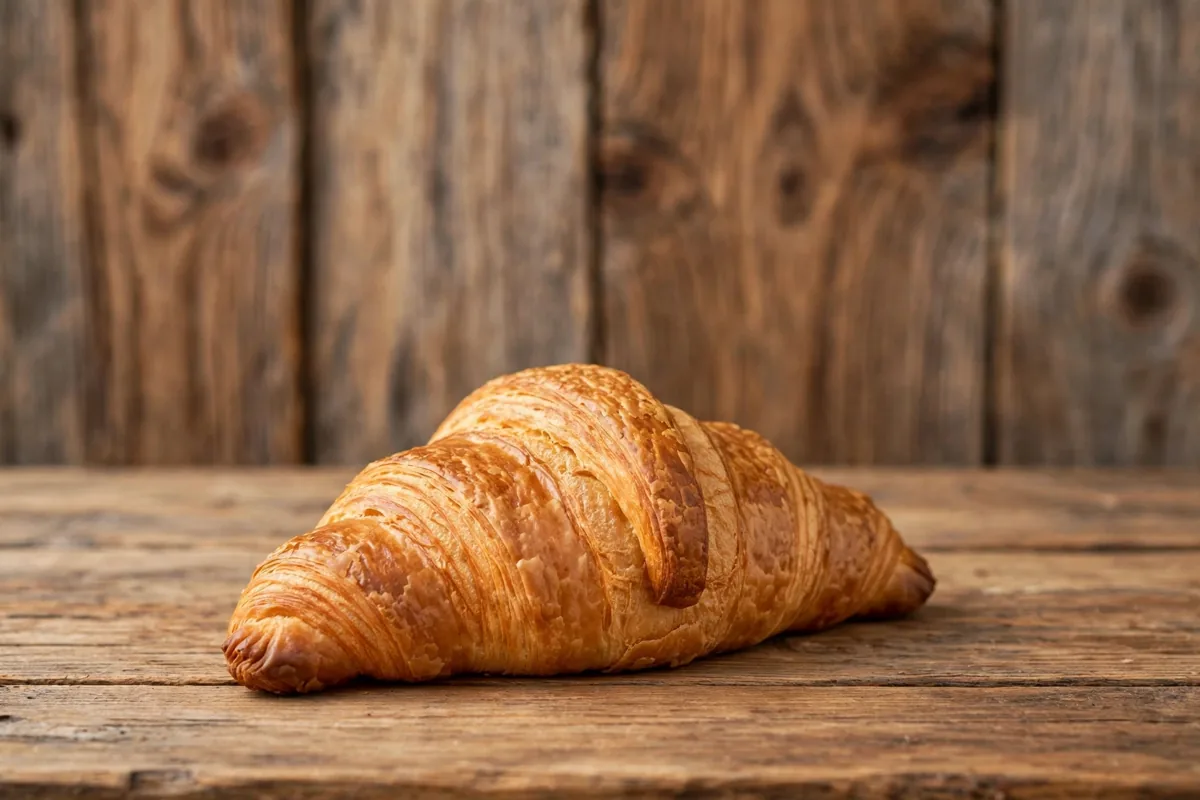
What is a croissant?
A croissant is a crescent-shaped, buttery, flaky pastry made from a yeast-leavened laminated dough: a dough that has been folded repeatedly around a block of butter to create dozens of thin alternating layers. Baked until deep golden, it has a crisp, shattering crust and a soft, honeycombed, slightly chewy interior.
It is one of the world's best-known breakfast pastries and the best-known example of viennoiserie, the French category of enriched, yeasted, often sweet baked goods that also includes brioche and pain au chocolat. Although it is closely associated with Paris, it is now baked in every part of the world, from neighborhood bakeries to supermarkets to airline kitchens.
History of the croissant
The Austrian ancestor
The croissant's ancestor is the kipferl, a crescent-shaped bread or biscuit known across Austria, Germany, Hungary and the wider central European region for centuries. Kipferl were made from a plain or lightly enriched dough and were not flaky. A popular legend says a Viennese baker invented the crescent in 1683 to celebrate the defeat of the Ottoman siege, mimicking the crescent on the Ottoman flag. Food historians consider this story a myth: it appears long after the supposed event and has no solid contemporary evidence.
Arrival in Paris
The documented link to France is better established. In 1838 or 1839 (sources differ, though Paris newspapers announced the opening in November 1839), an Austrian entrepreneur and former artillery officer named August Zang opened the Boulangerie Viennoise at 92 rue de Richelieu in Paris. It sold Viennese-style breads and pastries, including kipferl, and its patented steam oven was a novelty in the city. Viennese baking became fashionable, and French bakers began making their own versions, a trend that gave us the term viennoiserie. The name croissant appears in print in France by 1853, among the "fantasy" or luxury breads.
From crescent roll to laminated pastry
The flaky croissant is a French refinement. The earliest known recipe for the present-day croissant, a yeast-leavened dough laminated with butter as in puff pastry, dates from 1905, according to food historian Jim Chevallier. A recipe in Auguste Colombié's Nouvelle Encyclopédie culinaire followed in 1906, and the chef Sylvain Claudius Goy published another in his 1915 book La Cuisine anglo-américaine, which some sources treat as the first. Before then, croissants were made from enriched bread dough, containing eggs and sometimes butter, rather than from laminated dough. Combining the Viennese shape with the lamination technique of French pastry-making produced something new: the croissant we know today.
By the 1920s the croissant was a staple of Parisian cafés, and over the twentieth century it spread across the world. In the late 1970s, factory-made frozen dough turned it into a fast food that unskilled staff could bake fresh, and as of 2008 an estimated 30 to 40 percent of the croissants sold in French bakeries and pâtisseries were baked from frozen dough. That convenience also opened a wide gap in quality between industrial and artisan versions. Today a good all-butter croissant is widely treated as a benchmark of a bakery's skill.
Timeline: key dates
- Renaissance onward: Crescent-shaped breads are baked in Central Europe, and the Austrian kipferl is the croissant's direct ancestor. It is made from plain or lightly enriched dough and is not flaky.
- 1683: The Ottoman siege of Vienna fails. A popular legend says Viennese bakers invented the crescent roll to celebrate, but historians treat the story as a myth.
- 1838 or 1839: August Zang opens the Boulangerie Viennoise at 92 rue de Richelieu in Paris, selling Viennese breads including kipferl. Paris newspapers announce it in November 1839.
- 1853: The name croissant appears in print in France among the "fantasy" or luxury breads.
- 1905 and 1906: The earliest known recipes for the modern laminated yeast croissant appear, in 1905 according to Jim Chevallier and in 1906 in Colombié's Nouvelle Encyclopédie culinaire.
- 1915: Sylvain Claudius Goy publishes a laminated croissant recipe in La Cuisine anglo-américaine, which some sources treat as the first.
- 1920s: The croissant is a staple of Parisian cafés.
- 1965: Pillsbury introduces refrigerated crescent-roll dough in the United States, a convenience version of the shape.
- Late 1970s: Frozen, preformed dough turns the croissant into a fast food that can be baked fresh by unskilled staff.
- 2008: An estimated 30 to 40 percent of croissants sold in French bakeries and pâtisseries are baked from frozen dough.
- 10 May 2013: Dominique Ansel launches the cronut in New York, the best-known croissant hybrid.
Ingredients
A classic croissant needs only a handful of ingredients, so quality matters.
- Strong (bread) flour: high protein gives the dough the strength to stretch into thin layers without tearing.
- Butter: a high-fat (about 82 percent), low-water butter is preferred. It is used in two ways: a small amount mixed into the dough, and a larger block folded in as the lamination layer.
- Milk and/or water: hydrates the flour. Milk adds richness and aids browning.
- Yeast: fresh or instant, in modest quantity, so the dough rises slowly and develops flavor.
- Sugar: a small amount feeds the yeast, supports browning and softens the crumb.
- Salt: seasons the dough and balances the butter.
- Egg wash: egg mixed with a little milk or cream, brushed on before baking for a glossy, golden finish.
As a rough guide, a typical formula uses 100 percent flour, 50 to 55 percent liquid, 10 to 12 percent sugar, about 2 percent salt, 1.5 to 2 percent instant yeast, and enough lamination butter to equal about half the weight of the flour.
How a croissant is made
Croissant-making is a test of temperature control and patience. It usually takes around 24 hours, though most of that is resting time.
- Mix the dough (détrempe). Combine flour, liquid, yeast, sugar, salt and a small amount of butter, and mix just until smooth. Rest it in the refrigerator, often overnight, to relax the gluten and develop flavor.
- Prepare the butter block. Shape cold butter into a flat square. It should be pliable but still cold, with the same firmness as the dough.
- Enclose the butter (lock-in). Wrap the dough around the butter block, like an envelope, and seal the edges.
- Laminate. Roll the dough into a long rectangle and fold it, usually with three single (letter) folds, chilling between each. Three letter folds create 27 layers of butter between dough. Too few folds give a bread-like result, while too many blend the layers together.
- Rest and chill. Resting between folds keeps the butter solid and the dough easy to roll.
- Cut and shape. Roll the dough to about 4 mm thick, cut long triangles, and roll each from the wide end to the tip. Curve the ends slightly to form the crescent.
- Proof. Let the shaped croissants rise at about 24 to 27°C (75 to 80°F) until visibly puffy and jiggly. Warmer than this and the butter melts out; too cool and they won't rise.
- Bake. Brush with egg wash and bake at around 190 to 200°C (375 to 400°F) for 15 to 20 minutes, until deeply golden. Steam from the butter and dough pushes the layers apart.
What a great croissant looks like
When judging a croissant, look for:
- Color: deep golden to mahogany, not pale or uniform.
- Shape: well-defined, even layers visible on the outside.
- Cross-section: an open, honeycomb crumb with irregular air pockets, not a dense, bready center.
- Sound and texture: an audible crackle on the first bite, followed by a tender interior.
- Flavor: noticeably buttery with a slight sweetness and a faint yeasty, fermented depth.
Variations around the world
- Pain au chocolat (also called chocolatine in southwest France): the same dough rolled around dark chocolate batons.
- Almond croissant (croissant aux amandes): a day-old croissant filled and topped with frangipane and sliced almonds, then rebaked.
- Cornetto (Italy): a sweeter, softer, often filled relative, typically eaten at the bar with coffee.
- Medialuna (Argentina, Uruguay): smaller and sweeter, with a sugar glaze. A "de manteca" version uses butter and a "de grasa" version uses lard.
- Kipferl (Austria, Germany, Hungary): the non-laminated ancestor.
- Gipfeli (Switzerland): a regional cousin, often a little less rich.
- Cronut: a croissant-doughnut hybrid created by pastry chef Dominique Ansel in New York on 10 May 2013.
- Savory croissants: ham and cheese, spinach, or other fillings, which are especially popular in French cafés.
In France, a common convention is that a croissant au beurre, made with pure butter, is straight, while a croissant ordinaire, made with margarine or other fat, is curved. It is a convention rather than a rule. According to the national bakers' confederation, around 95 percent of the croissants sold in French bakeries are made with butter, and a croissant made half with butter and half with margarine cannot be sold as a croissant au beurre.
Common problems and fixes
- Butter leaking in the oven: proofing was too warm, the butter block was too soft, or the layers were not sealed. Control temperatures more closely.
- Dense, bready interior: too few folds, under-proofing, or dough that was too cold when shaped.
- Pale, flat croissants: under-proofing, oven too cool, or too little egg wash.
- Tough texture: over-worked dough or flour that is too strong without enough resting.
- Greasy results: butter that melted into the dough during rolling.
Serving and storing
Croissants are best the day they are baked, ideally within a few hours. Serve warm with butter and jam, with coffee or tea, or split and filled with ham and cheese. Keep leftovers at room temperature in a paper bag for a day, and refresh in a hot oven for 3 to 5 minutes. For longer storage, freeze baked croissants for up to a month, or freeze unbaked shaped dough and proof it fully before baking.
Nutrition snapshot
According to the USDA, a medium butter croissant (about 57 g) provides roughly 230 calories, which works out to about 406 calories per 100 g, with around 21 g of fat, 46 g of carbohydrate and 8 g of protein per 100 g. Values vary with size, recipe and fillings, so check the label or recipe for specifics.
Frequently asked questions
Is the croissant French or Austrian?
Both countries are part of the story. The crescent-shaped kipferl is Austrian and central European, but the flaky, yeast-leavened, laminated croissant as we know it was developed in France in the early 1900s.
Why are croissants so flaky?
Folding cold butter into dough creates dozens of alternating layers. In the oven, water in the butter turns to steam and pushes the dough layers apart, while the fat keeps them separate and crisp.
What is the difference between a croissant and a pain au chocolat?
They use the same laminated dough. A croissant is rolled into a crescent, while a pain au chocolat is rolled around one or two batons of dark chocolate into a rectangle.
Can you freeze croissants?
Yes. Freeze baked croissants for up to a month and refresh them in a hot oven, or freeze shaped, unproofed dough and proof it fully before baking.
Related pages
Sources
- Jim Chevallier, August Zang and the French Croissant: How Viennoiserie Came to France (2009)
- Smithsonian Magazine, Is the Croissant Really French?
- Europeana, The history of the croissant
- Word Histories, Viennoiserie: meanings and origin (2024)
- Pillsbury: crescent rolls, introduced 1965
- Dominique Ansel: the chef and the Cronut
- Confédération nationale de la boulangerie-pâtisserie française, Concours national du meilleur croissant au beurre: press kit (2024)
- USDA FoodData Central: Croissants, butter