Baguette
What is a baguette?
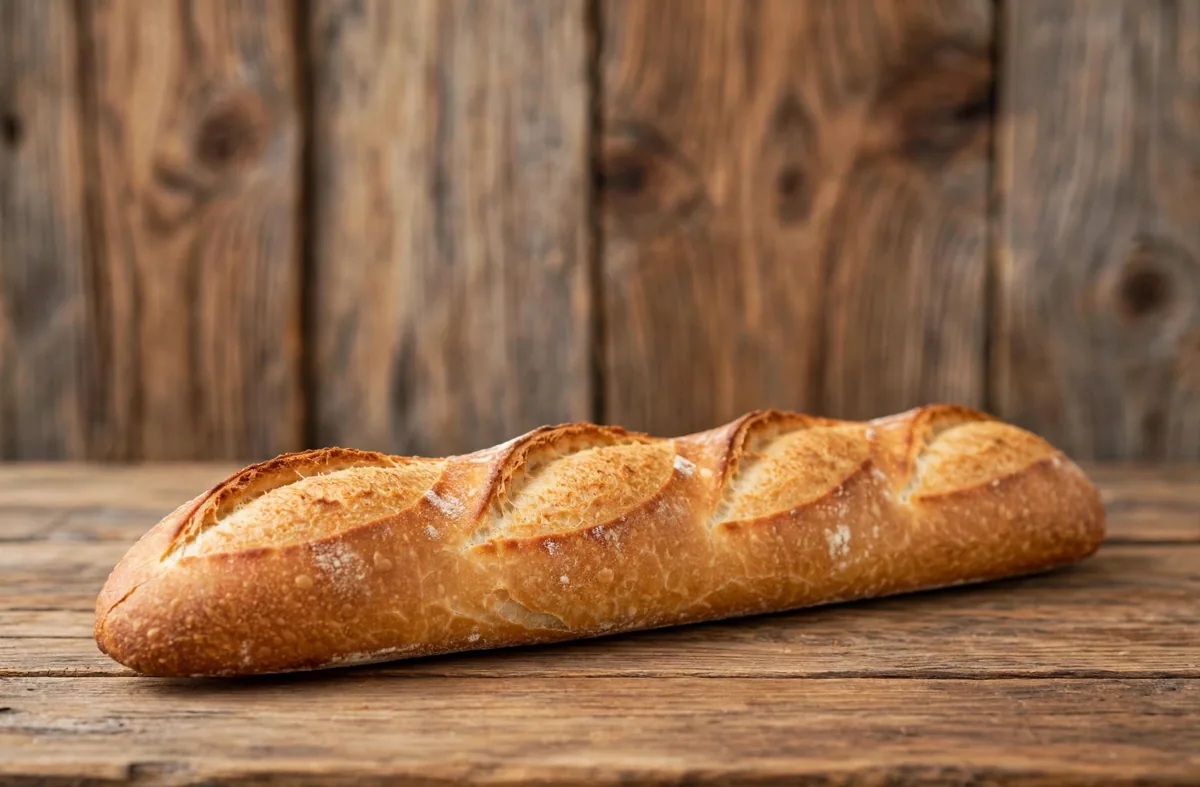
A baguette is a long, slender loaf of French wheat bread, recognizable by its crisp, blistered, golden crust and its soft, open, slightly chewy crumb. The word means "stick" or "wand," and a typical loaf is about 55 to 65 cm long, weighs roughly 250 g and is scored with a row of diagonal slashes. It is made from just four basic ingredients: flour, water, salt and yeast or sourdough.
Few foods are so tied to a country's identity. In France the baguette is bought fresh once or twice a day, carried home under an arm and eaten at nearly every meal: torn to mop up sauce, split for a jambon-beurre sandwich, or simply eaten warm with butter. It is also one of the best tests of a baker's skill, because a recipe with so few ingredients leaves nothing to hide behind.
History of the baguette
Long loaves before the baguette
Long, thin breads existed in France well before the word baguette was common. Parisian bakers had made long loaves, often called pains longs or flûtes, for generations, and rolls of many shapes were sold in the city's bakeries. What changed over time was the technology and the demand for a particular kind of crust.
Steam, Vienna and the crisp crust
A crucial development was the steam-injected oven. Food historian Jim Chevallier credits August Zang's Boulangerie Viennoise, opened in Paris in 1838 or 1839, with bringing steam ovens to the city. Steam keeps the surface of the dough flexible so the loaf can expand fully, and it then helps form the thin, shiny, crackling crust that we now associate with French bread. Some French sources go further and credit Zang with originating the baguette, but long, thin loaves are documented in Paris from the mid-eighteenth century.
Becoming the national loaf
The word baguette for a bread is first recorded in 1920, in a decree for the Seine department that set a minimum weight of 80 g, a maximum length of 40 cm and a maximum price for the loaf. How the word came to be applied to a bread so suddenly remains a mystery, and much of the baguette's early history is speculation.
A frequently repeated story says that a law banning bakers from working between 10 p.m. and 4 a.m., passed in 1919 and applied from 1920, pushed them to favor quick-baking thin loaves over slow-rising round ones. Historians doubt it: Chevallier notes that bakers who had been apprentices at the time said the law never really took effect, which makes it an unlikely explanation.
Over the twentieth century the baguette became the standard French loaf. By the 1990s, historians such as Steven Kaplan were criticizing the mass-produced baguette as bland, which helped inspire the 1993 decree described below.
The 1993 decree and a revival
In 1993 France introduced the Décret Pain (decree no. 93-1074 of 13 September 1993), which created the legal category of pain de tradition française, often sold as a baguette de tradition. It was meant to defend the craft loaf against industrial shortcuts. Such bread may contain only wheat flour, water, salt and yeast and/or sourdough, plus at most 2 percent fava bean flour, 0.5 percent soy flour and 0.3 percent malted wheat flour (by weight of the flour). It may not be frozen at any stage of its making and may contain no additives.
In 2022, UNESCO added the artisanal know-how and culture of baguette bread to its Representative List of the Intangible Cultural Heritage of Humanity, recognizing it as a living tradition rather than a product.
Timeline: key dates
- Mid-18th century: Long, thin loaves are baked in Paris, though the word baguette is not yet used for bread.
- 1838 or 1839: August Zang opens the Boulangerie Viennoise in Paris, bringing steam ovens to the city.
- 19th century: Very long loaves are a familiar sight in Paris, some far longer than a modern baguette.
- 1919 and 1920: A law bans night work in bakeries between 10 p.m. and 4 a.m., applied from 1920. Whether it shaped the baguette is disputed.
- August 1920: A decree for the Seine department sets size and price limits for a loaf called the baguette, the first record of the word for a bread.
- 13 September 1993: The Décret Pain creates the legal category of pain de tradition française.
- 2022: UNESCO adds the artisanal know-how and culture of baguette bread to its list of intangible cultural heritage.
Ingredients
The ingredient list is short, so quality and handling matter more than variety.
- Wheat flour: a moderate-protein bread flour with good extraction. French bakers use T55 or T65, which are classified by ash content rather than protein.
- Water: about 65 to 72 percent of the flour weight in a typical traditional dough, which gives the open crumb.
- Salt: around 2 percent of the flour weight, which seasons and also tightens the gluten.
- Yeast or sourdough: a very small amount of yeast (often 0.2 to 0.5 percent instant yeast) for a long fermentation, or a sourdough starter (levain). Many bakers also use a poolish or pâte fermentée, which is a portion of pre-fermented dough that adds flavor.
- Permitted extras (baguette de tradition): the decree allows at most 2 percent fava bean flour, 0.5 percent soy flour and 0.3 percent malted wheat flour, by weight of the flour, though many artisan bakers use none.
A classic recipe for four baguettes uses roughly 500 g flour, 350 g water, 10 g salt and 1 to 2 g instant yeast.
How a baguette is made
A baguette is simple in concept but exacting in practice. The key is time, temperature and gentle handling.
- Mix and rest (autolyse). Flour and water are combined and left for 20 to 60 minutes so the flour hydrates and the gluten begins to form. Salt and yeast are then added.
- Ferment (pointage). The dough rests for several hours at room temperature or, for more flavor, overnight in the refrigerator. During this time it is folded once or twice to build strength.
- Divide and pre-shape. The dough is cut into pieces of about 250 g and loosely shaped into rough cylinders, then rested for 15 to 30 minutes so it relaxes.
- Final shaping. Each piece is gently flattened, folded and rolled out to its full length, with the seam sealed along the underside. A good baker keeps as much gas in the dough as possible.
- Proof. The shaped loaves rest seam side up in the folds of a linen cloth (couche) for 45 to 60 minutes, until puffy but not fully risen.
- Score. Just before baking, the baker makes five to seven shallow, overlapping diagonal cuts with a razor blade, the grignes.
- Bake with steam. The loaves go into a very hot oven, around 230 to 250°C (450 to 480°F), with a burst of steam at the start. They bake for 20 to 25 minutes until the crust is deeply golden.
At home, you can recreate the steam by placing a tray of boiling water at the bottom of the oven and spraying the loaves with water just before baking. A baking stone or steel helps give the crust a strong start.
What a great baguette looks like
- Crust: deeply golden to chestnut, thin, shiny and crackling, with small blisters.
- Cuts: clearly opened, with a raised ridge (the ear) along each slash.
- Crumb: open and irregular, with a creamy, slightly translucent color and a glossy look.
- Aroma: wheaty, nutty and slightly sweet, with a faint tang if sourdough or a long ferment was used.
- Texture: the crust shatters, and the crumb is moist and chewy but not gummy.
- Freshness: a great baguette is warm or only a few hours old. It should sing softly when squeezed.
Variations and relatives
- Baguette ordinaire (standard): the everyday loaf, often made faster with a shorter ferment and sometimes with additives.
- Baguette de tradition: the regulated craft version, usually with more flavor and a rustic look.
- Ficelle: a thinner, shorter "string" loaf with more crust.
- Flûte: slightly thicker than a ficelle, a lighter weight.
- Bâtard: a shorter, fatter loaf with a similar crumb.
- Épi: a baguette cut into a wheat-sheaf shape that tears into pieces.
- Pain de campagne: a rustic country loaf, usually round, with some whole-wheat or rye flour.
- Bánh mì (Vietnam): the baguette's French colonial descendant, with a lighter crumb and thinner crust, used for sandwiches.
Common problems and fixes
- Pale, dull crust: not enough steam, oven too cool, or dough underproofed. Preheat well and add steam.
- No ear, cuts do not open: the cut was too deep or too flat, the dough was overproofed, or the surface dried out. Cut shallowly at a low angle.
- Dense, tight crumb: the dough was overworked, under-hydrated or shaped too forcefully.
- Flat loaves: weak gluten or overproofing. Build strength with folds and shorten the final proof.
- Tough crust: baked too long or too cool. Use a hotter oven and shorter bake.
- Bland flavor: fermentation too short. Use a cold overnight ferment.
Serving and storing
A baguette is at its best within a few hours of baking. Serve it with butter, cheese or soup, or split and fill it for a sandwich; the jambon-beurre (ham and butter) is a French classic. For storage, keep it in a paper bag or a cloth at room temperature for the day. After that, slice and freeze it, then toast the slices straight from the freezer. Do not store a baguette in a sealed plastic bag, which softens the crust.
Nutrition snapshot
Bread of this type provides roughly 250 to 280 calories per 100 g, mostly from carbohydrates, with a few grams of protein and very little fat. A whole 250 g baguette therefore contains around 650 to 700 calories, so a typical serving of a few slices is much less. Values vary with size and recipe.
Frequently asked questions
What is the difference between a baguette and a baguette de tradition?
A standard baguette can contain additives and be made from frozen dough. A baguette de tradition française is regulated in France: it must be made from wheat flour, water, salt and yeast or sourdough, with only a few tightly limited additions, and it cannot be frozen at any stage.
Why does a baguette go stale so quickly?
It has a high ratio of crust to crumb, no added fat and little sugar. Moisture migrates from the crumb to the crust within hours, so the crust softens and the crumb dries and firms. It is best eaten within about half a day of baking.
How can I bring a stale baguette back to life?
Run it briefly under the tap or mist it with water, then bake it in a hot oven (about 200°C / 400°F) for 5 to 8 minutes. The crust crisps and the crumb softens again, though this only works once.
How long is a baguette?
A standard baguette is typically about 55 to 65 cm long and weighs around 250 g, but sizes vary from shop to shop.
Why does a baguette have slashes on top?
The cuts (called grignes) control where the loaf expands in the oven. Without them the crust would tear unpredictably. Bakers aim for a confident, shallow cut that opens into a raised ridge, often called the ear.
Related pages
Sources
- Steven L. Kaplan, Good Bread Is Back: A Contemporary History of French Bread, the Way It Is Made, and the People Who Make It (2006)
- Encyclopaedia Britannica, Baguette
- Smithsonian Magazine, Is the Croissant Really French?
- Jim Chevallier, About the baguette: exploring the origin of a French national icon (2013)
- Décret n° 93-1074 du 13 septembre 1993 relatif aux pains et à la dénomination de boulanger (1993)