Ciabatta
What is ciabatta?
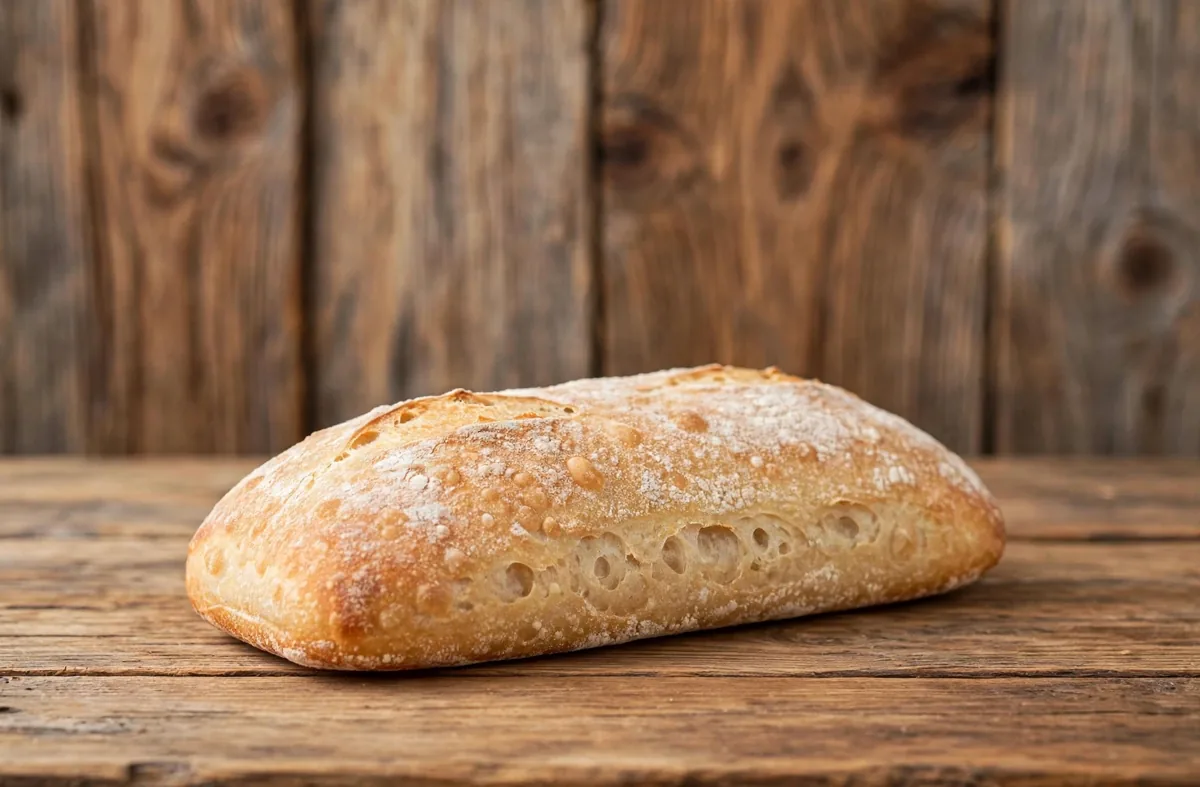
Ciabatta is a broad, flat, rustic Italian loaf with a thin, crisp, flour-dusted crust and a soft, chewy interior full of large, irregular holes. The name means "slipper" in Italian, a reference to its low, elongated shape. It is made from a very wet dough of wheat flour, water, salt and yeast, often with a little olive oil, and it is usually started with a pre-ferment called a biga.
It is one of Italy's best-known breads abroad, and one of its youngest. Unlike focaccia or the regional loaves that go back centuries, ciabatta was developed in the early 1980s to solve a specific commercial problem, and today it is the standard bread for panini and sandwiches in Italy and around the world.
History of ciabatta
A bread made to compete with the baguette
In the early 1980s, the French baguette had become the default bread for sandwiches in Italian sandwich shops. Italian bakers and millers were worried that imported baguettes were taking over a growing market. Arnaldo Cavallari, a rally driver and entrepreneur whose family owned the Molini Adriesi flour mill in Adria, in the Veneto region near Venice, set out to create an Italian alternative that would work just as well for filling.
1982: ciabatta is born
In 1982, working with the bakers Francesco Favaron and Arnaldo Cremonesi, Cavallari developed the loaf. The recipe came out of several weeks of experiments, and the flour came from his own mill. The new bread was broad and flat instead of long and thin, and it was named ciabatta after the slipper it resembled. Cavallari first called it ciabatta polesana, after the Polesine area where he lived, and registered the name as a trademark.
The credit for the invention itself is shared and disputed. Cavallari is the name most often associated with ciabatta, but the sons of Francesco Favaron say it was their father who personally invented the bread. It is clear that the idea, the milling and the marketing came from Cavallari's business, and that the baking expertise came from the bakers he worked with.
From Adria to the world
Cavallari's company was good at spreading the recipe. By 1999, Molini Adriesi had licensed it to bakers in 11 countries, and supporters of the bread say it is now known in more than 50. The licensing took ciabatta to countries as far apart as Australia and Brazil. Adria itself, a small town that few visitors had a reason to see, has recently started to promote itself as the birthplace of the bread.
Timeline: key dates
- Early 1980s: French baguettes dominate Italian sandwich shops, worrying Italian bakers and millers.
- July 1982: Arnaldo Cavallari begins work on an Italian alternative to the baguette in Adria, in the Veneto.
- 1982: The bread is developed with the bakers Francesco Favaron and Arnaldo Cremonesi and named ciabatta, "slipper." Cavallari registers the name ciabatta polesana as a trademark.
- 1999: Molini Adriesi has licensed the recipe to bakers in 11 countries.
- Today: Ciabatta is made and sold in dozens of countries, and Adria presents itself as its birthplace.
Ingredients
Ciabatta uses ordinary ingredients, but the proportions are unusual.
- Wheat flour: a strong bread flour (or Italian tipo 0 or 00) with enough protein to hold a very wet dough together.
- Water: a lot of it. Most bread recipes sit around 60 percent water relative to the flour, while ciabatta is usually 75 to 80 percent, and often more.
- Biga: a stiff Italian pre-ferment made from flour, water and a pinch of yeast, left to ferment for about 10 to 12 hours. It adds flavor, a softer crumb and better keeping quality. (A poolish, the wetter French equivalent, is also sometimes used.)
- Yeast: only a small amount, since the biga does much of the work.
- Salt: about 2 percent of the flour weight.
- Olive oil: optional, but common, often around 3 percent. It softens the crumb and adds flavor. Some recipes also use milk, though neither is required for a traditional loaf.
A home recipe for two loaves might use a biga made from about 150 g flour and 100 g water, plus a final dough of about 350 g flour, 280 g water, 10 g salt and a little olive oil.
How ciabatta is made
Ciabatta is known as a demanding bread to make because the dough is so wet and sticky. The secret is to build strength through folding and not through heavy kneading.
- Make the biga. Mix flour, water and a pinch of yeast into a stiff dough and let it ferment overnight at a cool room temperature, about 10 to 12 hours.
- Mix the dough. Combine the biga with more flour, water, salt, a little yeast and the olive oil. Mix until smooth and elastic. The dough will be very loose.
- Stretch and fold. Over about 2 to 3 hours, give the dough several sets of stretch-and-folds, usually three or four, spaced 30 to 45 minutes apart. Each set makes the dough stronger and traps more air. Use wet hands to keep it from sticking.
- Divide gently. Turn the dough out onto a generously floured surface and cut it into rectangles with a floured knife or scraper. Ciabatta needs minimal shaping, because every touch pushes out gas. Dipping scissors in water helps cut the dough without sticking.
- Rest briefly. Let the pieces rest for 30 to 45 minutes until puffy.
- Bake. Bake in a very hot oven, about 230°C (450°F), with steam at the start, for about 20 to 25 minutes, until the crust is golden and crisp. Cool on a rack.
What a great ciabatta looks like
- Crust: thin, crisp and golden, with a light dusting of flour.
- Crumb: open and irregular, with large, glossy holes and a creamy color.
- Texture: chewy and moist, with a springy bite, never dense or gummy.
- Shape: a broad, flat, slightly uneven rectangle. A perfectly regular loaf is a sign of too much handling.
- Flavor: wheaty and mildly sweet, with a little tang from the long fermentation and a hint of olive oil.
Variations
- Classic ciabatta: the original white version, usually made from tipo 0 flour.
- Whole-wheat ciabatta (integrale): made with part whole-wheat flour, for a denser crumb and nuttier flavor.
- Milk ciabatta (al latte): softer and slightly richer, with milk in the dough.
- Olive ciabatta: studded with olives, a popular flavored variety.
- Ciabatta rolls: the same dough divided into small pieces, used for individual panini.
- Ciabatta pizza base: the wet dough is also used for pizza. Some pizza makers in Adria still use Cavallari's original ciabatta flour mix for their bases.
Common problems and fixes
- Dense crumb with small holes: the dough was too dry, was overmixed or lost its gas through too much handling. Increase the water and handle the dough gently.
- Flat, spreading loaves: the dough was too weak or was overproofed. Do more stretch-and-folds.
- Pale, soft crust: the oven was too cool or lacked steam. Preheat well and add steam.
- Gummy center: underbaked. Bake until deeply golden and cool completely before cutting.
- Dough impossible to handle: this is normal for ciabatta. Use wet hands, a bench scraper and plenty of flour on the surface, but do not add flour to the dough.
Serving and storing
Ciabatta is best on the day it is baked, and its thin crust softens as it sits. Split it for panini, toast it for bruschetta, tear it to dip in olive oil, or cube it for croutons and panzanella. Store it in a paper bag at room temperature for a day, and freeze any extra, sliced, for up to a month. Refresh in a hot oven for a few minutes.
Nutrition snapshot
Ciabatta provides roughly 250 to 280 calories per 100 g, mostly from carbohydrate (about 46 to 52 g), with about 9 to 10 g of protein and 1 to 4 g of fat, depending on how much olive oil is used. A typical sandwich-sized slice of about 56 g is roughly 140 calories. Sodium is moderate to high, around 400 to 600 mg per 100 g in commercial loaves. Values vary by recipe and brand.
Frequently asked questions
Why is it called ciabatta?
Ciabatta is the Italian word for a slipper. The bread was named for its broad, flat, slightly elongated shape, which resembles a house slipper.
Is ciabatta an ancient bread?
No. Many people assume it has centuries of history, but ciabatta was created in 1982 in Adria, in Italy's Veneto region, as an Italian alternative to the French baguette for sandwiches.
Who invented ciabatta?
Credit is shared and disputed. Arnaldo Cavallari, a rally driver whose family owned the Molini Adriesi flour mill, is the name most often associated with it and registered it as a trademark. The baker Francesco Favaron worked with him on the recipe, and Favaron's sons say their father personally invented the bread.
Why does ciabatta have such big holes?
The dough is very wet, usually around 75 to 80 percent water relative to the flour or more, and it is handled gently with stretch-and-fold turns instead of heavy kneading. That builds a strong, elastic network that traps large, irregular gas bubbles.
What is ciabatta best used for?
It was designed for sandwiches, and it is the classic bread for panini. It is also excellent torn and dipped in olive oil, toasted for bruschetta, or cut into croutons.
Related pages
Sources
- Fodor's Travel, Italy's ciabatta bread was invented in 1982
- SBS Italian, The surprising history of ciabatta bread
- Drive Up (Mediaset), Il pane ciabatta è stato inventato da un pilota rally
- Alexandra's Kitchen, How to make fresh homemade ciabatta bread (2021)
- Salt, Butter, Smoke, Two day ciabatta
- USDA FoodData Central: Bread, ciabatta