Bagel
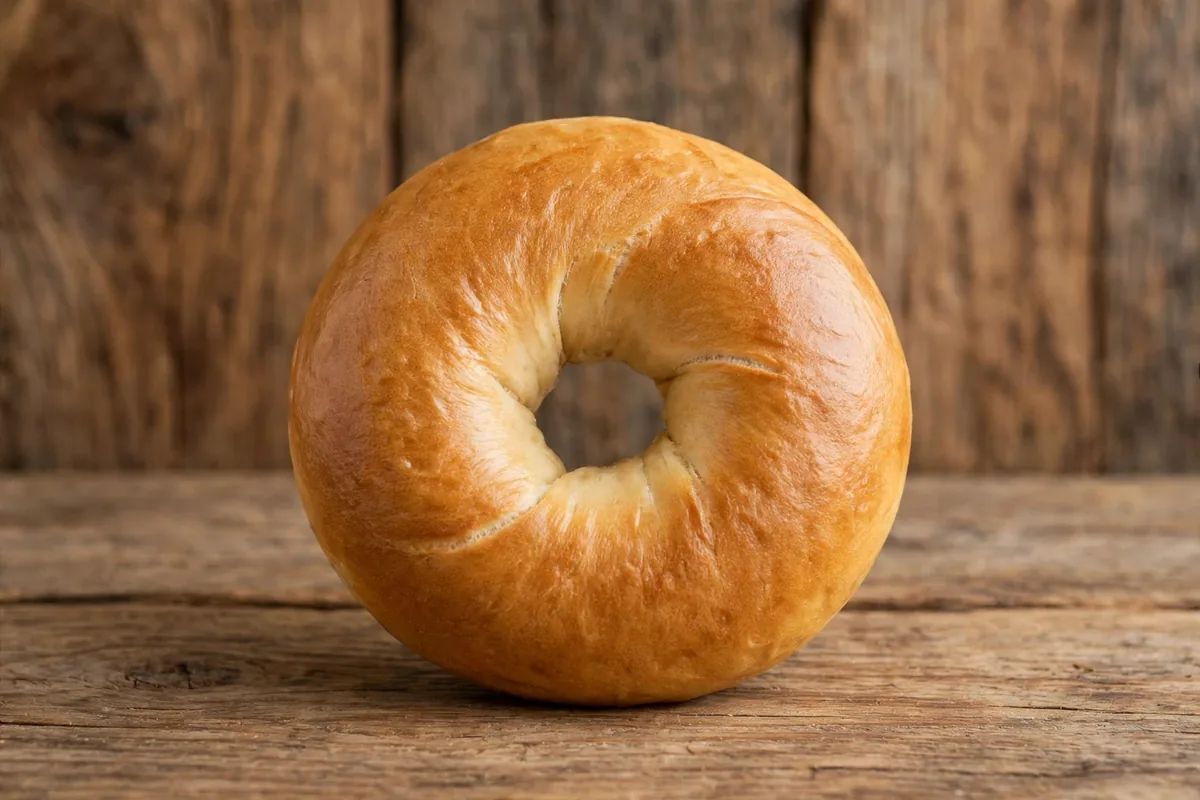
What is a bagel?
A bagel is a ring-shaped bread roll with a dense, chewy interior and a glossy, slightly crisp crust. What sets it apart from almost every other bread is how it is made: the shaped dough is briefly boiled in water before it is baked. That short bath gives the bagel its characteristic texture and shine.
Plain, sesame, poppy seed, onion, salt and "everything" (a mix of seeds, dried onion, garlic and salt) are the classic varieties, with cinnamon-raisin as the popular sweet option. Bagels are eaten split and toasted, topped with cream cheese, or filled for sandwiches. Across North America they are a standard breakfast, and in New York and Montreal they are a point of local pride.
History of the bagel
Origins in Central Europe
The bagel's roots lie in the Ashkenazi Jewish communities of Central and Eastern Europe. The earliest known mention of the word is in Kraków's community regulations of 1610, which list bagels as a gift for women in childbirth. The idea of a boiled ring bread is older: a 13th-century Syrian cookbook describes a boiled-then-baked ring bread called ka'ak, and Polish royal accounts from 1394 record a related bread called obwarzanek. Over the 16th and 17th centuries the bagel became a staple of Polish cuisine. The ring shape and the boil-then-bake method appear in several European breads, and the pretzel and the Turkish simit are close relatives. Some stories claim the bagel was invented to honor a king or a stirrup shape, but these tales are legends with no solid evidence.
The word itself comes from Yiddish beygl, related to a German word for ring or bracelet. In Poland, the related obwarzanek krakowski has been a protected geographical indication of the European Union since 2010.
Crossing the Atlantic
Millions of Jews emigrated from Eastern Europe to North America between the 1880s and the 1920s, and they brought their bakers with them. In New York's Lower East Side, bagels were made by hand in small bakeries. A bagel bakers' union, Local 338, was established in the early twentieth century; by 1915 it held contracts with 36 bakeries in the New York area, and for decades it controlled the city's bagel trade. Around 1900, the "bagel brunch" of bagel, lox and cream cheese became popular in New York. Bagels were largely a neighborhood food until the middle of the twentieth century, when they began to spread beyond Jewish communities.
Mass production and the modern bagel
The postwar decades changed the bagel. Daniel Thompson began work on the first commercially viable bagel machine in 1958, and machines went on sale in 1963, removing the need to roll each ring by hand. Lender's, the New Haven bakery Harry Lender founded in 1927, leased the technology and, from 1960 by the company's own account, froze its bagels so they could be shipped beyond New Haven. That made bagels a supermarket staple and ended the era of union-made, hand-rolled bagels. The bagel's reputation grew along with its availability, and by the 1980s and 1990s it had become a mainstream breakfast food in North America and well beyond.
Mass production also led to a backlash, because many supermarket bagels are soft, steamed rather than boiled, and puffy. Today a wave of artisan bakeries, in New York, Montreal and elsewhere, has revived the traditional boiled-and-baked bagel with long fermentation.
Timeline: key dates
- 13th century: A Syrian cookbook describes a boiled-then-baked ring bread called ka'ak, the earliest known mention of this technique.
- 1394: Polish royal accounts mention obwarzanek, a boiled ring bread and the ancestor of the Kraków obwarzanek.
- 1610: Kraków community regulations list bagels as a gift for women in childbirth, the earliest known mention of the word.
- 16th and 17th centuries: The bagel becomes a staple of Polish cuisine and is widely associated with Ashkenazi Jews from the 17th century.
- Around 1900: Polish Jewish immigrants build a bagel trade on New York's Lower East Side, and the "bagel brunch" of lox and cream cheese becomes popular.
- Early 1900s to 1915: New York's bagel bakers organize as Local 338, which by 1915 holds contracts with 36 bakeries in the area.
- 1919: Isadore Shlafman opens the Montreal Bagel Bakery, later Fairmount Bagel, the city's first bagel bakery.
- 1927: Harry Lender opens a bagel bakery in New Haven, Connecticut, the start of Lender's.
- 1957: Myer Lewkowicz opens St-Viateur Bagel in Montreal.
- 1958 to 1963: Daniel Thompson develops the first commercially viable bagel machine, which goes on sale in 1963.
- 1960: Lender's begins freezing bagels for shipment outside New Haven, by the company's account the first to do so.
- 1970s to 1980: The everything bagel appears, with several people claiming to have invented it.
- 2010: The European Union registers obwarzanek krakowski as a protected geographical indication.
Ingredients
A bagel has a very short ingredient list.
- High-gluten flour: with roughly 12.5 to 14 percent protein, it builds the strong, elastic structure that gives the bagel its chew.
- Water: only about 50 to 57 percent of the flour weight, which makes a stiff, low-hydration dough that is hard to knead by hand.
- Yeast: instant or fresh yeast, in moderate amounts.
- Salt: about 2 percent of the flour weight.
- Barley malt (syrup or powder): a traditional sweetener that gives the crust its color, a gentle sweetness and its shine. Some recipes use honey or brown sugar instead.
- Toppings: sesame, poppy seeds, dried onion and garlic, coarse salt or cinnamon sugar, pressed on after boiling.
A typical recipe for eight bagels uses about 500 g high-gluten flour, 280 g water, 10 g salt, 5 g yeast and 15 to 20 g barley malt syrup.
How a bagel is made
Making bagels is more physical than baking most breads. The dough is dense, and the process has an unusual extra step.
- Mix and knead. Combine the ingredients into a stiff dough and knead thoroughly, about 10 minutes by machine, until smooth and elastic.
- Divide and shape. Cut the dough into pieces of about 100 to 120 g. Shape each into a ball, then form a ring by poking a hole through the center and stretching it, or by rolling a rope and joining the ends around your hand.
- Rest overnight (cold ferment). Place the shaped bagels on a tray and refrigerate for 12 to 18 hours. This slow ferment develops flavor and helps blister the crust.
- Boil. Bring a pot of water to a gentle boil, with barley malt syrup or honey added. Boil each bagel for 30 to 60 seconds per side.
- Top. While the surface is still wet, dip or press the bagel into seeds or toppings.
- Bake. Bake on a sheet or a baking stone at around 220 to 245°C (430 to 475°F) for 15 to 25 minutes, until deep golden brown.
Cool on a rack. Bagels are best eaten within a few hours, though they toast well the next day.
What a great bagel looks like
- Crust: shiny, thin and slightly crisp with small blisters, deep golden brown, not pale or matte.
- Crumb: dense, chewy and even, with small holes rather than big air pockets.
- Size and shape: a clear, open hole with a round, evenly shaped ring.
- Flavor: slightly sweet and malty with a mild tang from the long fermentation.
- Bite: a noticeable resistance when you tear it, not squishy or doughy.
Variations around the world
- New York bagel: large, plump and chewy, boiled in malted water and baked in a conventional oven. The city's water is often credited for the result, but this is more tradition than proven science.
- Montreal bagel: smaller, thinner and sweeter, with a large hole. The dough contains malt and sugar but no salt, the bagels are boiled in honey-sweetened water, and they are baked in a wood-fired oven. Sesame and poppy seed are the classic toppings. The city's best-known bakeries are Fairmount Bagel, opened in 1919, and St-Viateur, opened in 1957.
- Bialy: a related roll from Białystok, Poland, baked rather than boiled, with a depression in the middle filled with onion.
- Jerusalem bagel: a long, oval, sesame-covered bread sold from street carts, related but distinct.
- Simit (Turkey): a sesame-coated ring bread dipped in grape molasses before baking.
- Everything bagel: a modern American invention covered in seeds, dried onion, garlic and salt. It likely dates from the 1970s or early 1980s, and its exact origin is disputed: David Gussin of Queens says he created it around 1980, while others claim earlier dates.
- Flavored bagels: blueberry, cheese, whole wheat and others, which many purists consider less authentic.
Classic ways to eat a bagel
The most famous pairing is bagel and lox: a split, toasted bagel with cream cheese, thinly sliced cured salmon, red onion, tomato and capers. Plain cream cheese or butter, egg and cheese sandwiches, and peanut butter are other common choices. In Montreal, bagels are often eaten plain, still warm from the oven.
Common problems and fixes
- Not chewy enough: the flour has too little protein, the dough is too wet or it was underkneaded. Use high-gluten flour and knead longer.
- Wrinkled or blistered skin: the bagels were overproofed or left too long in the refrigerator. Reduce the rest time.
- Flat or collapsed in the water: overproofed dough, or water that is too hot. Boil gently.
- Pale, matte crust: too little time in the water, no malt or sugar in the water, or a cool oven.
- Hole closes up: the hole was too small when shaped. Make it larger than you think you need.
- Too dense: underproofed or overly stiff dough.
Serving and storing
A bagel is best on the day it is baked. Store it in a paper bag at room temperature for a day, and avoid refrigeration, which makes it stale faster. For longer storage, slice the bagels first and freeze them in a sealed bag, then toast straight from frozen. Never microwave a bagel for long, because it turns rubbery.
Nutrition snapshot
A typical bagel provides roughly 260 to 350 calories, mostly from carbohydrates, with around 10 g of protein, 1 to 4.5 g of fat and 2 to 5 g of fiber, depending on size. Bagels have grown over time: hand-rolled bagels weighed about 2 to 3 ounces (57 to 85 g) in the early twentieth century, while the average bagel sold on a Manhattan coffee cart in 2003 weighed about 6 ounces (170 g). Toppings and spreads add more.
Frequently asked questions
Why are bagels boiled before baking?
A brief boil sets the surface of the dough and gelatinizes its starch. That stops the bagel from rising too much in the oven and gives it a shiny, thin, chewy crust and a dense interior, which is the main difference between a bagel and a bread roll.
What is the difference between a New York bagel and a Montreal bagel?
New York bagels are larger, puffier and chewier, made with malt and boiled in plain or malted water before baking in a regular oven. Montreal bagels are smaller, thinner and sweeter, with a larger hole. They are boiled in honey-sweetened water and baked in a wood-fired oven.
Why are bagels so chewy?
They are made from a stiff, low-hydration dough using high-protein flour, which builds a strong gluten network. The boiling step then tightens the crust, so the bagel resists biting and has a dense, elastic crumb.
Can you freeze bagels?
Yes. Slice them first, freeze in a sealed bag for up to three months, and toast straight from the freezer.
Is a bagel Jewish?
The bagel developed within Ashkenazi Jewish communities of Central and Eastern Europe and became a staple of Jewish-American food, especially in New York. Today it is eaten by people of every background.
Related pages
Sources
- Maria Balinska, The Bagel: The Surprising History of a Modest Bread (2008)
- Gil Marks, The Encyclopedia of Jewish Food (2010)
- Commission Regulation (EU) No 977/2010 entering Obwarzanek krakowski in the register of protected geographical indications (2010)
- The Humble Bagel (Center for Jewish History) (2016)
- The Christian Science Monitor, Battle of the bagels (Fairmount and St-Viateur) (2008)
- Progressive Grocer, Murray Lender, bagel mogul, dies at 81 (2012)
- NPR, Food fight erupts over the 'everything' bagel (2008)