Pretzel
What is a pretzel?
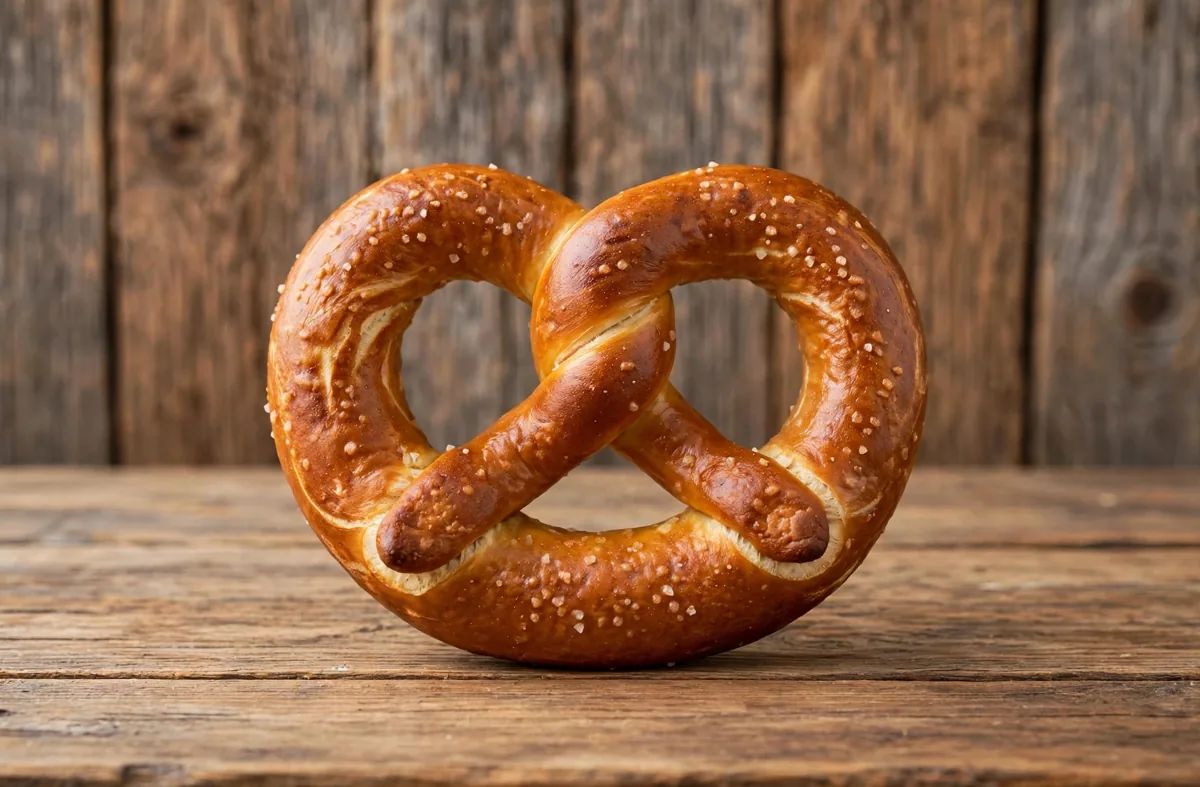
A pretzel is a knot-shaped baked good made from a wheat dough that is briefly dipped in an alkaline solution before baking. That dip, usually a lye bath in Germany, is what gives the pretzel its deep mahogany crust, its glossy shine and its distinctive savory, slightly tangy flavor. The inside stays soft and chewy, and the outside is topped with coarse salt.
The classic shape, with two arms crossed over a round belly, is one of the most recognizable symbols in baking. In southern Germany the pretzel is still the emblem hung over many bakery doors, and the word Brezel (also Brezn or Breze in Bavarian) is understood by everyone. Today the pretzel comes in two main families: the soft pretzel, eaten fresh, and the hard, crunchy pretzel sold as a snack.
History of the pretzel
Legends and evidence
The most popular story says that an Italian or French monk invented the pretzel in 610, folding strips of leftover dough into the shape of a child's arms crossed in prayer, and handing them out to pupils as rewards for learning their prayers. It is a charming tale, but food historian William Woys Weaver says there is no documentation for it, and that the legend was promoted heavily by the pretzel industry in the mid-twentieth century. Another story credits bakers held hostage by local dignitaries, and one more claims that pretzel bakers saved Vienna during the Ottoman siege of 1529. None of these stories is supported by solid evidence.
What the evidence does show is that the pretzel was well established in southern Germany by the twelfth century. It had become the emblem of bakers and their guilds in that region by then, and a twelfth-century illustration of a banquet in the Hortus Deliciarum, an encyclopedia compiled in Alsace by Herrad of Landsberg between about 1167 and 1185, may contain the earliest depiction of a pretzel.
Lent, luck and love
Pretzels became closely tied to religious life. Because they contain no eggs or dairy, they were considered suitable food for Lent, when the Church's fasting rules were strict. The knot also took on symbolic meanings: in seventeenth-century Germany, children wore pretzel necklaces at New Year as a charm for good luck and prosperity, and the interlocking loops came to stand for lasting love. The loops may have had a practical use too: in a painting by the Dutch artist Job Berckheyde from around 1681, pretzels hang on sticks in a bakery, so the loops let bakers hang them up.
Crossing the Atlantic
German immigrants brought pretzels to Pennsylvania from about 1710, and they became a staple of the local bakeries run by the Pennsylvania Dutch (the English name for those German-speaking settlers). In 1861 Julius Sturgis opened a pretzel bakery in Lititz, Pennsylvania, which is generally described as the first commercial pretzel bakery in the United States, although earlier bakers made pretzels in the region. Sturgis is also credited, by his family's business, with making the first deliberately hard pretzels. Pennsylvania has been the center of American pretzel baking ever since, and more than 80 percent of hard pretzels sold in the United States are still made there.
In 1935 the Reading Pretzel Machinery Company introduced the first automated pretzel-twisting machine. Before then, a skilled hand twister could shape about 240 pretzels an hour. In 1988 Anne Beiler, better known as Auntie Anne, began selling soft pretzels at a farmers market in Pennsylvania Dutch country, the start of a franchise that now has more than 1,500 locations.
Timeline: key dates
- 610 (legend): A monk in Italy or France is said to have invented the pretzel. No documentation supports the story.
- 12th century: The pretzel is in use as an emblem of bakers and their guilds in southern Germany.
- About 1167 to 1185: Herrad of Landsberg compiles the Hortus Deliciarum in Alsace, which may contain the earliest depiction of a pretzel.
- 17th century: In Germany, children wear pretzel necklaces at New Year for good luck.
- About 1681: Job Berckheyde paints a bakery in which pretzels hang on sticks.
- About 1710: German immigrants begin settling in Pennsylvania and bring pretzel baking with them.
- 1861: Julius Sturgis opens a pretzel bakery in Lititz, Pennsylvania, generally called the first commercial pretzel bakery in the United States.
- 1935: The Reading Pretzel Machinery Company introduces the first automated pretzel-twisting machine.
- 1988: Anne Beiler starts the soft pretzel business that becomes Auntie Anne's.
Ingredients
A pretzel dough is simple and fairly stiff.
- Wheat flour: a bread flour with moderate to high protein, for a chewy crumb.
- Water: a fairly low amount, which keeps the dough firm enough to shape into thin ropes.
- Yeast: a small amount of instant or fresh yeast.
- Salt: about 2 percent of the flour weight inside the dough.
- Butter or lard: a little fat, which makes the crumb softer and more tender.
- The alkaline bath: either a 3 to 4 percent solution of food-grade sodium hydroxide (lye) or, at home, a baking soda solution.
- Coarse pretzel salt: large grains that stay intact during baking and give the pretzel its crunch and visual identity.
A typical recipe for six large pretzels uses roughly 500 g flour, 280 g water, 10 g salt, 25 g butter and 3 g instant yeast.
How a pretzel is made
- Mix and knead. Combine the dough ingredients and knead until smooth and elastic, then let it rest and rise for about an hour.
- Divide and roll. Cut the dough into pieces of about 100 to 120 g. Roll each into a long rope, about 60 cm, thicker in the middle and tapering toward the ends.
- Shape. Form a U, cross the ends twice, and press them down onto the belly of the U. This is the classic pretzel knot.
- Chill. Rest the shaped pretzels uncovered in the refrigerator for 30 minutes to overnight. The surface dries slightly and firms up, which makes them easier to dip.
- Dip in the alkaline bath. Dip each pretzel in a cold 3 to 4 percent lye solution for about 10 to 30 seconds, using gloves and eye protection, then let it drain. Add the lye to the water, never the other way around. For a home alternative, simmer pretzels briefly in a baking soda bath.
- Slash and salt. Cut a shallow slit across the thickest part of the belly and scatter coarse salt on top.
- Bake. Bake in a hot oven, about 220°C (425°F), for 12 to 16 minutes, until deep brown.
Lye is a corrosive chemical, so it requires care: wear gloves and goggles, use stainless steel or glass containers, and keep it away from children. A baking soda bath is a safe and perfectly acceptable alternative for home bakers.
What a great pretzel looks like
- Color: deep, even mahogany brown with a glossy sheen.
- Belly: it splits open along the slash, revealing a soft, pale interior.
- Arms: thin and crisp, contrasting with the soft belly (in the Bavarian style).
- Crumb: soft, chewy and fine-grained, not airy like ordinary bread.
- Flavor: savory and slightly alkaline, with a touch of bitterness from the bath and bursts of salt.
Variations around the world
- Bavarian Brezn: the classic, with a thick belly and thin arms.
- Swabian Laugenbrezel: thinner and more even throughout, with a thin, crisp crust.
- Butterbrezel: a pretzel split and filled with butter, a common German snack.
- Laugenweck (pretzel roll): the same dough and lye bath shaped into rolls.
- Alsatian bretzel: the pretzel as made in Alsace, in eastern France.
- Anise pretzel: a regional variety from Upper Franconia in Germany.
- American soft pretzel: a large, soft pretzel in the Pennsylvania Dutch tradition, sold fresh and popularized nationally by chains such as Auntie Anne's.
- Hard pretzel: a baked, crunchy, long-lasting version, popular in the United States and centered on Pennsylvania.
- Filled and flavored pretzels: cheese-filled, cinnamon-sugar and chocolate-coated versions are common in the United States.
Common problems and fixes
- Pale, dull crust: the bath was too weak or too short, or you used plain baking soda. Use a stronger solution or bake the soda first.
- Slimy or gummy surface: the pretzels stayed in the bath too long. A lye dip is only seconds.
- Bitter, harsh taste: the lye solution was too strong or the pretzels were not drained well.
- Pretzels unravel while baking: the ends were not pressed firmly into the belly.
- Tough, dense crumb: too much flour, too much kneading or too little rise.
- Soft, soggy salt: use coarse pretzel salt and apply it after dipping, just before baking.
Serving and storing
Soft pretzels are best fresh from the oven, plain or with butter, mustard or cheese. In Germany they are a classic with wheat beer. Store them uncovered for a few hours, because a sealed bag softens the crust. For longer storage, freeze them in a sealed bag and refresh them in a hot oven for 5 minutes. Hard pretzels keep for weeks in an airtight container.
Nutrition snapshot
According to the USDA, soft pretzels provide roughly 340 to 345 calories per 100 g, with about 8 g of protein, 3 to 4 g of fat and 69 g of carbohydrate. A large soft pretzel of about 115 g therefore provides around 390 calories. Hard pretzels are lighter in weight but denser in calories, at about 380 calories per 100 g. Pretzels are also high in sodium because of the salt on top.
Frequently asked questions
Why are pretzels dipped in lye?
Traditional German pretzels are dipped, briefly and cold, in a 3 to 4 percent solution of food-grade sodium hydroxide before baking. The alkali boosts browning on the surface, which gives the deep mahogany color, the glossy crust and the distinctive savory, slightly bitter flavor.
Can I use baking soda instead of lye?
Yes. A baking soda bath is the usual home alternative and works well, but the pretzels come out paler and the crust is less chewy and less distinctive. Baking the soda in the oven first makes it more alkaline and brings the result closer to lye.
Did a monk invent the pretzel in 610?
There is no documentation for that story. Food historian William Woys Weaver notes that the legend has no historical basis and was promoted heavily by the pretzel industry in the twentieth century. The earliest solid evidence is from the 12th century.
What is the difference between a Bavarian and a Swabian pretzel?
A Bavarian Brezn has a thick belly and thin arms, so the crust contrasts with a soft center. A Swabian Laugenbrezel is thinner and more even in thickness throughout, with a thin, crisp crust all over.
How should I store pretzels?
Soft pretzels are best eaten the day they are baked, because the crust softens as they sit. Freeze extras in a sealed bag and refresh them in a hot oven for a few minutes.
Related pages
Sources
- Atlas Obscura, Pretzels for Lent
- History.com, The Pretzel: A Twisted History
- Sturgis history (Julius Sturgis Pretzel Bakery)
- Go Reading Berks, Five generations of pretzels: the Tom Sturgis story
- World Grain, A twisted work of art
- King Arthur Baking, Making pretzels at home (2018)
- USDA FoodData Central: Pretzels, soft