Brioche
What is brioche?
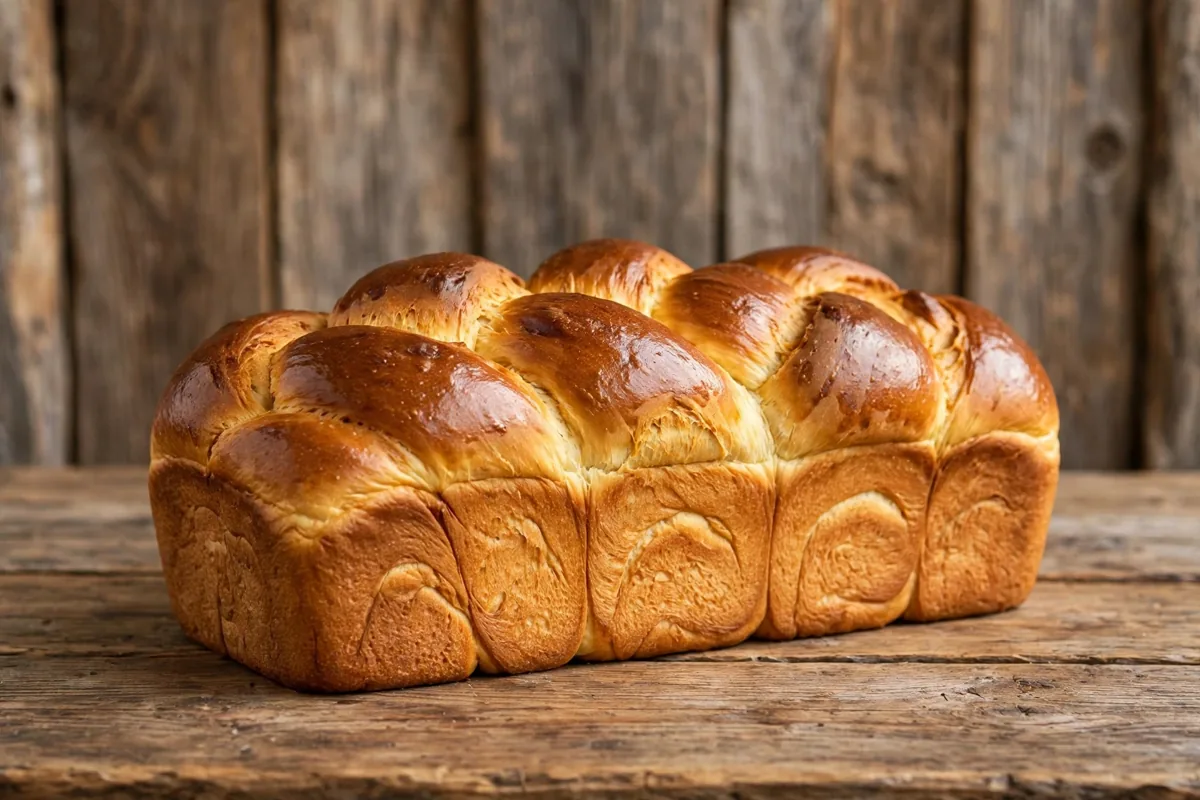
Brioche is a French enriched bread with a soft, golden, buttery crumb and a thin, glossy crust. It is made from a yeast dough loaded with eggs and butter, which makes it far richer, lighter and more tender than ordinary bread. The texture is often described as somewhere between bread and cake, and it tears into long, silky strands.
It is eaten at breakfast, split and toasted, served with jam or chocolate, used for burger buns, or turned into French toast and bread pudding. Together with the croissant and the pain au chocolat, it is one of the cornerstones of French viennoiserie, although unlike them it is not laminated, meaning it has no layers of folded butter.
History of brioche
Origins and the word
The word brioche is first recorded in French in 1404 and is closely associated with Normandy, a region famous for its butter. It is widely accepted to come from the Norman verb brier, "to knead," a dialect form of broyer, meaning to pound or work dough, a reference to the long, hard work the dough requires. In 1611, the English lexicographer Randle Cotgrave described it in his French–English dictionary as a spiced bun and gave its origin as Norman. Enriched breads made with eggs and fat are much older and exist in many European traditions, so brioche is better understood as a French refinement than as a single invention.
From festive treat to bakery staple
For centuries, rich breads were a luxury. Butter and eggs were expensive, so brioche was a festive food, associated with holidays, weddings and religious feasts, and the amount of butter in the dough signaled the baker's generosity. Regional versions grew up around France, from the Norman gâche to the praline-studded brioche of Savoie and Lyon.
Brioche reached Paris in the seventeenth century, when the poet and lexicographer Antoine Furetière described it as a delicate pastry made with butter and eggs. In that period brioche and blessed bread (pain bénit) were sometimes used almost interchangeably, and by the eighteenth century brioche increasingly replaced blessed bread, with the loaves from the Norman butter markets of Gisors and Gournay the most highly regarded.
The "let them eat brioche" myth
One of the most repeated food stories in history says that Marie Antoinette, told that the people had no bread, replied, "Let them eat cake," often rendered as brioche. There is no evidence she ever said this. A very similar line appears in Rousseau's Confessions. The first six books, which include the passage, were written in 1765 (and finished by about 1769) and published in 1782; they attribute the remark to an unnamed "great princess." Marie Antoinette was then a child in Austria and did not arrive in France until 1770. The line was first linked to her in print in 1843, decades after her death, and historians consider the attribution a myth.
Timeline: key dates
- 1404: The word brioche is first recorded in French.
- 1611: Randle Cotgrave's French–English dictionary describes brioche as a spiced bun of Norman origin.
- 17th century: Brioche reaches Paris, where Antoine Furetière describes it as a delicate pastry made with butter and eggs. Brioche and blessed bread (pain bénit) overlap in this period.
- 18th century: Brioche increasingly replaces blessed bread, and loaves from the Norman butter markets of Gisors and Gournay are the most highly regarded.
- 1765 to 1769: Jean-Jacques Rousseau writes the first books of his Confessions, including the "great princess" passage. Marie Antoinette is a child in Austria.
- 1770: Marie Antoinette arrives in France.
- 1782: The Confessions are published.
- 1843: The "let them eat brioche" line is first linked to Marie Antoinette in print, decades after her death.
- Today: Brioche is a pillar of French viennoiserie, and its dough is used for loaves, regional specialties, burger buns and French toast.
Ingredients
The ingredient list is simple, but the proportions are unusual.
- Wheat flour: a strong bread flour with good protein, which gives the dough the structure to hold a lot of fat.
- Butter: the defining ingredient, and the more there is, the richer the result. A classic dough uses butter equal to around 40 to 50 percent of the flour weight, and very rich versions go as high as the flour weight itself.
- Eggs: whole eggs (and sometimes extra yolks) provide moisture, richness, color and structure. They replace much of the water.
- Sugar: about 10 to 15 percent of the flour weight, for sweetness and browning.
- Yeast: more than in a lean bread, because the fat and sugar slow fermentation.
- Salt: about 2 percent of the flour weight.
- Milk or water: a small amount, only as needed.
- Egg wash: a beaten egg brushed on twice for a deep, glossy finish.
A basic recipe for one loaf uses roughly 500 g flour, 4 to 5 eggs, 250 g soft butter, 60 g sugar, 10 g salt and 10 to 15 g fresh yeast.
How brioche is made
Brioche takes patience, and a stand mixer helps considerably.
- Mix the base dough. Combine the flour, eggs, sugar, salt, yeast and a little milk, and knead the dough until smooth.
- Develop the gluten. Knead at medium speed for 10 to 15 minutes until the dough is elastic and starts to pull away from the bowl. This step is vital, because butter weakens gluten, so the gluten must be strong before the fat goes in.
- Add the butter. Add the soft but still cool butter in small pieces, kneading until it is fully absorbed. The dough will turn glossy, silky and very soft.
- First rise. Let the dough rise at room temperature for about an hour, then chill overnight (8 to 12 hours). Chilling firms the butter and makes the dough manageable.
- Shape. Divide and shape cold. For a loaf, place several balls side by side in a tin (the nanterre style). For a brioche à tête, form a large ball and press a smaller ball on top in a fluted mold.
- Proof. Let the shaped brioche rise at about 24 to 27°C (75 to 80°F) for 1.5 to 3 hours, until it has roughly doubled and looks airy.
- Egg wash and bake. Brush with beaten egg, then bake at about 180°C (350°F) for 25 to 35 minutes for a loaf, or about 190°C (375°F) for 12 to 15 minutes for small buns, until deeply golden.
A well-baked loaf sounds hollow when tapped and reaches an internal temperature of about 90°C (195°F). Cool on a rack.
What a great brioche looks like
- Crust: thin, shiny and evenly golden brown, never pale or dull.
- Crumb: fine, soft and feathery, which pulls apart in long, silky strands.
- Flavor: distinctly buttery and gently sweet, with a faint yeasty depth. It should not taste greasy.
- Texture: springy and moist, not dry or crumbly, and not heavy or doughy.
- Aroma: warm butter and a slight caramelized egg note.
Variations and regional types
- Brioche à tête (Parisienne): the classic small brioche with a "head," baked in a fluted mold.
- Brioche Nanterre: a loaf formed from balls of dough in a rectangular tin, which creates a scalloped top.
- Brioche tressée: a braided loaf.
- Brioche vendéenne: from the Vendée region, often perfumed with orange blossom water or rum and sometimes braided.
- Brioche de Saint-Genix (Savoie): a large brioche studded with pink pralines.
- Gâche (Normandy and western France): a rich bread related to brioche, with regional variations.
- Brioche feuilletée: a laminated brioche, mixing the brioche dough with a layered technique.
- Italian "brioche": in Italy, the word is often used for a sweet croissant-like pastry served at the bar. In Sicily, brioche col tuppo is a round brioche with a small topknot, famously split and filled with ice cream for summer breakfast.
- Burger buns: brioche-style buns are widely used for gourmet burgers.
- Brioche perdue: French toast made from brioche, a popular way to use up stale slices.
Common problems and fixes
- Butter leaking out in the oven: the proof was too warm or the butter was too soft when mixed. Keep the dough cool.
- Dense, heavy crumb: underproofed, underkneaded or too much flour. Be patient with both kneading and proofing.
- Dry brioche: overbaked. Bake just until golden, and cover with foil if the top browns too fast.
- Pale top: too little egg wash or an oven that is too cool.
- Dough too sticky to handle: do not add much flour. Chill it instead.
- Collapsed after baking: overproofed. Shorten the final rise.
Serving and storing
Brioche is best on the day it is baked, warm or at room temperature, with butter and jam, chocolate spread or cheese. It also makes excellent toast and French toast. Keep it in a bag at room temperature for two to three days, or freeze it for up to a month. Day-old brioche is ideal for bread pudding.
Nutrition snapshot
Because of the butter, eggs and sugar, brioche is calorie-dense. Bakery brioche typically provides about 375 to 430 calories per 100 g (the USDA lists roughly 427), mostly from fat and carbohydrate, with about 9 to 10 g of protein. A 60 g roll is therefore roughly 225 to 255 calories. Commercial brioche buns are lighter, at around 270 to 320 calories per 100 g. Values vary with recipe and size.
Frequently asked questions
Is brioche a bread or a pastry?
It sits between the two. Brioche is a yeast-raised bread dough enriched with large amounts of eggs and butter, so it is treated as bread in construction but eaten more like a pastry. In France it belongs to the category of viennoiserie.
Did Marie Antoinette say 'let them eat brioche'?
There is no evidence she did. A similar line is attributed to an unnamed 'great princess' in Jean-Jacques Rousseau's Confessions, written when Marie Antoinette was still a child in Austria. The quote was later pinned on her, but historians consider the attribution a myth.
What is the difference between brioche and challah?
Both are enriched with eggs, but brioche is rich in butter and sugar and has a very soft, cake-like crumb. Traditional challah is made with oil rather than butter, is usually only lightly sweet, and has a chewier texture.
Why is brioche dough so hard to work with?
It contains a lot of butter and egg, so it is soft, sticky and slow to develop gluten. The dough must be chilled, usually overnight, so the butter firms up and the dough can be shaped without tearing.
How should I store brioche?
Keep it in a bag at room temperature for two to three days. For longer storage, freeze it sliced or whole, and refresh in a low oven. Day-old brioche is excellent for French toast.
Related pages
Sources
- Jean-Jacques Rousseau, Les Confessions (Book VI) (1782)
- Online Etymology Dictionary, Etymology of brioche
- The Collector, Did Marie Antoinette really say 'let them eat cake'? (2026)
- Appetito Magazine, Gelato, sorbetto, granita and how to spot the real thing
- Larousse Gastronomique
- USDA FoodData Central: Brioche