Baked goods of France
France separates daily bread (boulangerie), cakes and tarts (pâtisserie) and enriched morning pastries (viennoiserie), and protects the baker's title by law.
Baking in France
Few countries are as closely identified with baked goods as France. A morning visit to the local bakery for a fresh baguette or a croissant is a daily ritual for millions of people, and the shop windows of Paris pâtisseries are as much a part of the country's image as its wine and cheese. France's contribution goes beyond individual recipes: it also shaped the professional language of baking, from lamination and choux to the idea of a bakery as a craft with its own standards.
Three words organize the French baking world, and knowing them helps with everything below:
- Boulangerie: a bakery that makes bread, and usually viennoiserie and a few simple pastries. French law protects the boulangerie designation: the bread must be kneaded, fermented, shaped and baked on the premises where it is sold.
- Pâtisserie: a shop devoted to cakes, tarts and fine pastries such as éclairs and mille-feuille. The craftsperson is a pâtissier.
- Viennoiserie: enriched, yeasted morning pastries such as croissants, pains au chocolat and brioche, so called because of their Viennese roots. Many boulangeries make them, and so do specialist shops.
Timeline: key dates
- 1651: François Pierre de La Varenne's cookbook Le Cuisinier françois contains the earliest known recipe for the mille-feuille.
- 17th century: Brioche reaches Paris.
- 1790s: Carmelite nuns in Nancy bake and sell the single-shell almond macarons that Nancy still claims.
- 1838 or 1839: August Zang opens the Boulangerie Viennoise in Paris, bringing Viennese breads and steam ovens to the city.
- 1850s and 1860s: The éclair, earlier known as pain à la duchesse, takes its name, first attested in the 1860s.
- About 1860: The kouign-amann appears in Douarnenez, Brittany, attributed to the baker Yves-René Scordia.
- 1862: Louis Ernest Ladurée opens his Paris pastry shop.
- 1880s: The Tatin sisters make their upside-down apple tart famous at the Hôtel Tatin in Lamotte-Beuvron.
- 1905: The earliest known recipe for the modern laminated croissant appears.
- 1910: Louis Durand creates the wheel-shaped Paris-Brest in Maisons-Laffitte.
- 1920: The word baguette is first recorded as a kind of bread.
- About 1930: The double-shell Parisian macaron is credited to Pierre Desfontaines of Ladurée.
- 1993: The Décret Pain creates the legal category of pain de tradition française.
- 1994: Paris launches its annual Grand Prix de la Baguette de Tradition Française.
- 2022: UNESCO adds the artisanal know-how and culture of baguette bread to its list of intangible cultural heritage.
The classic French baked goods
Baguette
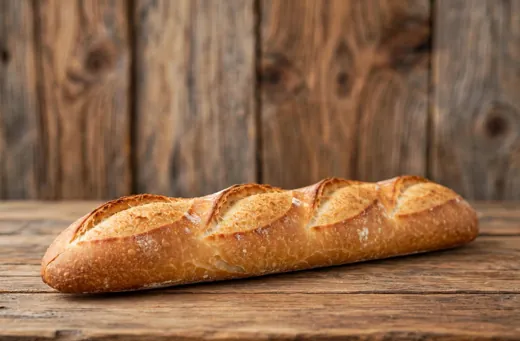
The long, thin loaf with a crackling crust and open, chewy crumb is France's most recognizable bread. A standard baguette is typically about 65 cm long and weighs around 250 g, though no legal text fixes its size. A baguette de tradition française is regulated by the 1993 bread decree: it may contain only wheat flour, water, salt and yeast or sourdough, plus tiny permitted amounts of fava, soy and malted wheat flour, with no additives and no freezing at any stage. Since 1994, Paris has held an annual contest for the best traditional baguette. The winning baker receives €4,000 and supplies the Élysée Palace for a year. In 2022 UNESCO recognized baguette-making as intangible cultural heritage. Read the full baguette guide.
Croissant
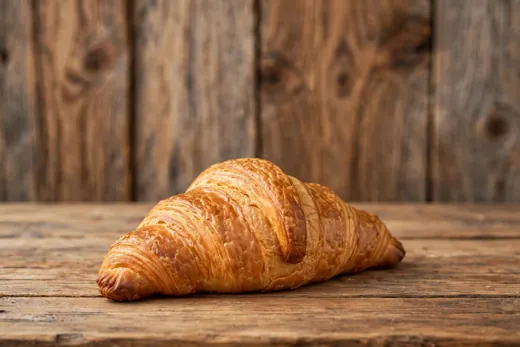
The buttery, flaky crescent is France's best-known pastry, even though its ancestor, the kipferl, came from Austria. The laminated yeast version we know today took shape in France in the early twentieth century, with the earliest known recipe dating from 1905. In French bakeries, a straight croissant is traditionally the butter version (croissant au beurre) and a curved one the margarine version. See the full croissant guide.
Pain au chocolat
Made from the same laminated dough as the croissant, wrapped around batons of dark chocolate. In much of southwest France it is called chocolatine, and the choice of name remains a good-natured regional argument.
Brioche
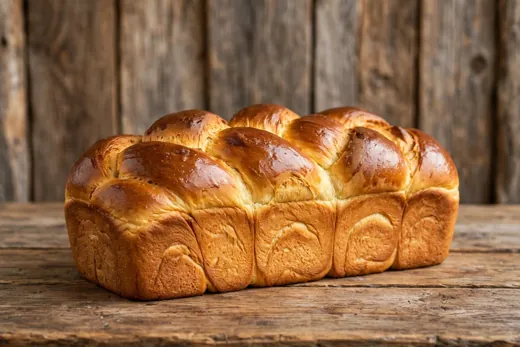
A rich, soft bread enriched with eggs, butter and sugar. The word is first recorded in French in 1404, and brioche reached Paris in the seventeenth century. It exists in many forms, from the small brioche à tête to the Saint-Genix, a Savoie brioche studded with pink pralines. It is also the base for French toast, known as pain perdu. Read the full brioche guide.
Éclair
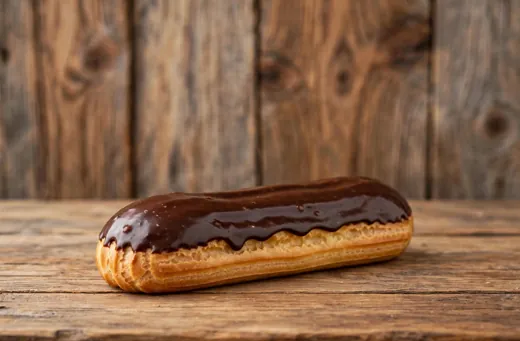
An oblong choux pastry filled with cream and topped with glossy icing. The name means "lightning," and it is first attested in the 1860s. Before then the pastry was known as pain à la duchesse. Some historians link it to the chef Antonin Carême in the early nineteenth century, though its exact origin is uncertain. Classic flavors are coffee and chocolate; modern pâtisseries offer many more. Read the full éclair guide.
Macaron
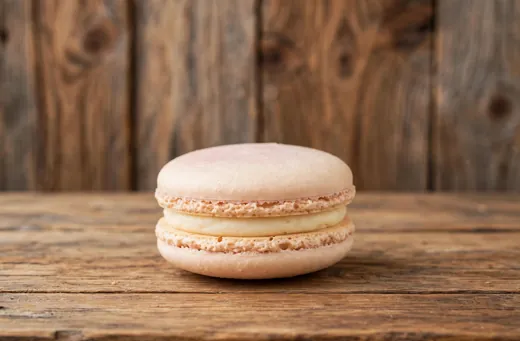
The Parisian macaron is a pair of delicate almond meringue shells sandwiched with ganache, buttercream or jam. Single-shell almond macarons are much older and survive in places such as Nancy, where the story begins with Carmelite nuns in the 1790s. The filled, two-shell version is credited to Pierre Desfontaines of the Paris pâtisserie Ladurée, founded in 1862, around 1930, although the baker Claude Gerbet also claims it. Read the full macaron guide.
Mille-feuille
Literally "a thousand leaves," this dessert layers crisp puff pastry with pastry cream and is finished with a fondant glaze, often marbled with chocolate. The earliest known recipe is in La Varenne's 1651 cookbook, and Carême refined it in the early nineteenth century. In North America it is often called a Napoleon, and in Britain a vanilla slice.
Tarte Tatin
An upside-down caramelized apple tart, baked with the fruit under the pastry and then turned out. It is named after Stéphanie and Caroline Tatin, who ran a hotel in Lamotte-Beuvron in the Loire region in the 1880s. The popular tale that Stéphanie made it by accident is a legend: upside-down tarts already existed in the area, and the sisters made the tart famous rather than inventing it.
Canelé
A small fluted pastry from Bordeaux with a deep, dark, caramelized crust and a soft, custardy interior flavored with vanilla and rum. Traditionally baked in copper molds, it is a symbol of the southwest, and a good one balances a thick crust with a tender middle.
Madeleine
A small, shell-shaped sponge cake with a characteristic bump, linked to the town of Commercy in Lorraine. It is also famous in literature: Marcel Proust's In Search of Lost Time describes the taste of a madeleine dipped in tea unlocking a flood of childhood memories.
Paris-Brest
A ring of choux pastry filled with praline cream and topped with sliced almonds. It was created in 1910 by Louis Durand, a pastry chef in Maisons-Laffitte, to commemorate the Paris–Brest–Paris bicycle race, which had started in 1891. The wheel shape is deliberate.
Kouign-amann
A specialty of Brittany whose Breton name means "butter cake." Layers of dough, butter and sugar are folded together and baked until deeply caramelized outside and tender within. It originated around 1860 in Douarnenez, where it is attributed to the baker Yves-René Scordia, and the strict original recipe uses 40 percent dough, 30 percent butter and 30 percent sugar.
Regional baked goods of France
France's baking is deeply regional, shaped by local grains, dairy and fruit.
- Brittany: kouign-amann, far breton (a dense custard cake with prunes) and salted-butter shortbread biscuits.
- Normandy: apple tarts and cakes, reflecting the region's orchards and dairy.
- Alsace: kougelhopf, a yeasted ring cake baked in a fluted mold; soft pretzels; and plum tarts.
- Lorraine: madeleines, macarons from Nancy, and tarts made with mirabelle plums.
- Bordeaux and the southwest: canelés, the Basque gâteau basque (filled with pastry cream or black cherry jam), and chocolatine.
- Provence: fougasse, a flat bread often scented with olives or herbs, and the traditional thirteen desserts of Christmas.
- Lyon and the Alps: pink-praline tarts, which are a local specialty, and the pink-praline brioche of Saint-Genix in Savoie.
- Burgundy: pain d'épices, a honey-spiced loaf associated with Dijon.
- Paris and the Île-de-France: the home of Paris-Brest, the Parisian macaron, and the large pâtisserie tradition.
Seasonal and festive baking
Many French baked goods are tied to the calendar. The galette des rois, a flaky almond-cream tart eaten around Epiphany in January, hides a small figurine called the fève, and whoever finds it is "king" or "queen" for the day. The bûche de Noël, a rolled sponge cake decorated like a log, is a Christmas staple, and many regions have their own Easter breads and pastries.
How to buy well in France
A few habits help you find the good stuff:
- Look for a bakery that bakes on site. The protected boulangerie designation is a good start, though quality still varies.
- Choose bread with character. A baguette de tradition is generally more flavorful than a standard baguette.
- Ask for "au beurre." A croissant au beurre is made with butter, and the national bakers' confederation says about 95 percent of croissants sold in French bakeries are.
- Go early for bread and croissants. They are best soon after baking, while many pâtisserie items are made for the day.
- Follow the line. In French neighborhoods, a steady queue is often the best review.
FAQ
What is France's most famous baked good? The baguette is the national symbol of bread, and the croissant is the best-known pastry worldwide.
What is the difference between a boulangerie and a pâtisserie? A boulangerie sells bread and often viennoiserie, while a pâtisserie specializes in cakes, tarts and fine pastries.
Is the baguette protected by law? The traditional baguette is regulated by a 1993 decree that limits its ingredients and methods, and the term boulangerie is legally protected.
What are the best French pastries for a first visit? A croissant for breakfast, an éclair or mille-feuille from a pâtisserie, and a canelé or kouign-amann if you are visiting Bordeaux or Brittany.
Baked goods from France
Sources
- Larousse Gastronomique
- Décret n° 93-1074 du 13 septembre 1993 relatif aux pains et à la dénomination de boulanger (1993)
- Encyclopaedia Britannica, Baguette
- Time Out, The best baguette in Paris has been crowned (2023)
- Smithsonian Magazine, Is the Croissant Really French?
- Afar, The éclair affair: revamping a classic
- Sortiraparis, Ladurée, the French macaroon legend since 1862
- Sortiraparis, History of French pastry: where does the mille-feuille come from?
- TarteTatin.org, History of the tarte Tatin
- Taste of France, Paris-Brest
- Food52, The story of France's most extraordinary pastry (kouign-amann) (2019)